


Chernobyl NPP: from disaster to nuclear terrorism


фото: Reuters/Vasily Fedosenko
April 26 marks the 40th anniversary of the largest man-made disaster in human history, the Chernobyl nuclear power plant accident. Then, during an experiment at reactor 4, two explosions occurred. During the current Russian-Ukrainian war, Chernobyl experienced another drama, the intensity of which is comparable to the Chernobyl accident 40 years ago.
It has been 40 years since the Chernobyl nuclear power plant accident, but its consequences are still being discussed by the world scientific community. According to the definition of UNSCEAR and WHO, the Chernobyl disaster is classified as a nuclear facility accident of the highest level. Historians emphasize the political responsibility of the communist regime, which for the sake of ideological interests endangered the lives and health of millions of citizens.
Due to the imperfection of the design, violation of construction technology, and the use of poor-quality building materials, such a man-made disaster became inevitable. The criminal concealment of information by the authorities, on the one hand, deepened the irreparable negative consequences of the accident, and on the other, it caused the activation of the ecological and national-democratic movements, which ultimately led to the collapse of the USSR.

1986. What happened on the night of April 26?
On April 25, 1986, the fourth power unit at the Chernobyl nuclear power plant was to be experimentally shut down to study the possibilities of using the inertia of the turbogenerator in the event of a power outage. Despite the fact that technical circumstances did not correspond to the test plan, the test was not canceled.

The experiment began on April 26 at 01:23. The situation got out of control. At 01:25, two explosions occurred with an interval of a few seconds. The reactor completely collapsed. More than 30 fires broke out. The main ones were extinguished after an hour, and the fire was completely eliminated by 5 a.m. on April 26. However, later an intense fire broke out in the central hall of Unit 4, which was fought using helicopters until May 10.

At the time of the accident, 17 workers were in the building of Unit 4. Valery Khodemchuk, the senior operator of the reactor shop, died under the rubble. On the afternoon of April 26, repairman Volodymyr Shashenok died from radiation. 11 workers received doses of radiation. They all died of radiation sickness by May 20, 1986 in Moscow Hospital No. 6. Another 14 people from the station’s personnel received doses that caused radiation sickness of the 3rd and 4th degrees.

The day after the accident, a government commission decided to immediately shut down Units 1 and 2 and evacuate the population of Pripyat (the so-called 10-kilometer zone). However, even the highest officials were not fully aware of the danger.

The military personnel were immediately thrown into the liquidation work. The first to arrive at the scene of the disaster were several dozen soldiers and officers of the Civil Defense Regiment of the Kyiv Military District with radiation reconnaissance devices and an army equipment decontamination kit, a mobile detachment of chemical troops, and a separate company of radiation and chemical reconnaissance. According to incomplete data, 600 thousand people took part in the liquidation of the consequences. Many of them fell ill due to radiation.

Firefighters arrived “bare-handed”, without any protective equipment, such as special insulating gas masks, which caused radioactive substances to enter the respiratory tract. It was the firefighters who stopped another potential disaster – a hydrogen explosion. The total activity of radioisotopes released into the air after the Chernobyl accident was 30-40 times higher than in Hiroshima. Almost 8.5 million people were irradiated.

What was the Soviet government hiding?
Information about the man-made disaster caused by the explosion and subsequent destruction of the 4th power unit of the Chernobyl NPP was immediately classified by the party and state leadership of the USSR and the Soviet special services. As evidenced by archival documents, the KGB of the Ukrainian SSR immediately began to develop and implement a set of special measures to classify information about the accident at a regime facility. This was fully consistent with the totalitarian regime.

In addition, the KGB of the USSR issued a special document listing information that people were not allowed to know. This included the true causes of the accident, the nature of the destruction and the extent of damage to the equipment and systems of the power unit and the nuclear power plant, the radiation situation, the actual state of the reactor core, the degree of impact on people at the nuclear power plant, along with information about the nature of their activities and the characteristics of the accident, the exposure of the plant personnel, repair personnel of the organizations involved, and the population, etc.

The Chernobyl disaster was one of the catalysts for the collapse of the USSR. The accident was the last straw that broke the glass of human patience. The authorities’ concealment of the truth about the disaster and its consequences, the lack of information about safety measures, and the insufficient assistance to the victims shook faith in the values of the communist idea even among its most loyal supporters.

2022. Occupation of the Chernobyl Nuclear Power Plant
The Russian aggressor used the Chernobyl nuclear power plant and the post-disaster protection facility to carry out aggression and a full-scale invasion in 2022. On February 24, 2022, units of the invaders advancing from the Republic of Belarus entered the exclusion zone, seized the facilities of the Chernobyl nuclear power plant, and took the station’s personnel hostage.

On the night of February 25, a mechanized enemy column advanced from Chernobyl in the direction of Ivankov – up to 300 units of equipment in the direction of Fenevichi, Katyuzhanka, Dymer (Vyshgorod direction). The equipment of the enemy military transport columns had no identification marks, but they included white cars (probably disguised as OSCE) and civilian cars, most likely with landing troops or DRG.
In March 2022, the enemy was accumulating forces in the area of the Chernobyl NPP, the Shelter facility, and the exclusion zone in general. This had extremely dangerous consequences, in particular, it led to an increased threat of radiation contamination of the area, created the prerequisites for an emergency situation at particularly dangerous facilities, etc.

The illiterate actions of Russian commanders, who decided to deploy the personnel of three BTGs in the so-called Red Forest (an area with a particularly high level of radiation contamination in the area of the Chernobyl NPP), caused mass exposure of the personnel of these units.
On March 31, 2022, Russian troops completely withdrew from the territory of the Chernobyl NPP. The occupiers forced the station employees to sign “official” documents, allegedly stating that the Russian Federation had been “guarding” the facility since February 24, 2022.
During the withdrawal, the Russian military managed to rob the premises, steal equipment and other valuables. Leaving the station, the occupiers captured and took to the Russian Federation the civilian employees of the Chernobyl NPP and the National Guardsmen who were guarding it.

There is another moment from the time of the Russian presence at Chernobyl: the Russian military dug in inside the exclusion zone and even dug trenches in the so-called Red Forest. This is a forest that was literally burned out by radiation during the 1986 accident, and it really does have the red, burnt-out color of dead, frozen trees.
This Red Forest is terribly radioactive, and Russian commanders ordered their subordinates to dig trenches there, because they thought that Kyiv would fall and they would have to stay in the exclusion zone for a long time. Also, heavy military equipment moved through these forests and areas, turning over layers of radioactive soil, thereby raising the radiation level in the area.

There were also reports of nausea and vomiting among Russian soldiers, and of elevated radiation levels in some parts of the Chernobyl zone, the peace of which had been disturbed by a month of Russian occupation. The end of this occupation of the zone was put by Ukraine’s victory in the battle for Kyiv, specifically the liberation of the strategic village of Moshchun on the Irpin River, which made the encirclement of Russian troops a real possibility.

And when the city of Irpin was liberated on March 28, 2022, the Russian command announced the withdrawal of troops from the Kyiv and Chernihiv regions. Thus, 35 days of Russian occupation of the Chernobyl zone passed. “We breathed a sigh of relief. Thank God!” – said one of the station employees at the time.
It turned out that the station staff had kept five Ukrainian blue-and-yellow flags hidden in their changing lockers, and people took them out and unfurled them when the occupiers left. One of the flags was raised on a flagpole near the Chernobyl nuclear power plant during lunch break on the first day of liberation.

2025. A blow to confinement
On February 14, 2025, a Russian strike drone carrying a high-explosive warhead hit the shelter of the destroyed Chernobyl Nuclear Power Plant Unit 4. According to IAEA experts, the new safe confinement at the Chernobyl Nuclear Power Plant, damaged by the drone strike, lost key safety functions, but its main structures and monitoring systems were not permanently damaged.
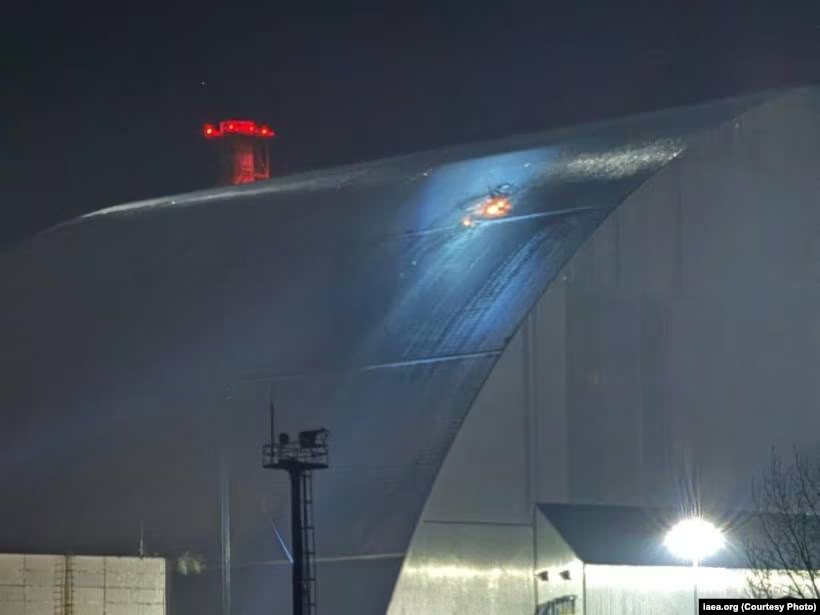
Recall that the new confinement, built in 2019, covered the reactor destroyed by the explosion and a temporary shelter, hastily built in 1986. This arch was built nearby, and then the dangerous object was dragged over on rails and covered, so that later both the old shelter and the destroyed reactor could be dismantled inside, with special attention to four and a half tons of nuclear materials.
The Western press called the confinement “an analogue of the pyramids of ancient Egypt” – such a unique object had never existed in the world before. But even that did not stop Russia, whose drone hit the new shelter directly, making a large hole.

The facility is still being restored after a Russian drone struck the New Safe Confinement (NSC) at the Chernobyl nuclear power plant in February 2025. Some of the containment has been lost, but the shelter continues to contain radioactive materials inside the destroyed fourth power unit.
According to the state-owned specialized enterprise “Chernobyl NPP”, the situation at the station remains under control: no excess radiation background is recorded, all indicators are within normal limits.
The IAEA, which has been operating at the site since 2023, confirmed that the design tightness of the NSC was violated. At the same time, no damage to the supporting structures and monitoring systems was detected, as well as no radiation emissions.

At the same time, Greenpeace Ukraine has published a report that discusses the more serious consequences of the attack. According to the organization, a hole has formed in the roof of the NSC, some structures have been damaged, and temperature and humidity control systems have stopped working. They believe that without urgent repairs, the risks to the facility will increase.
Currently, work is underway at the Chernobyl NPP to restore the tightness of the shelter. According to official estimates, the risk of uncontrolled radiation release remains minimal.
What does the fourth power unit of the Chernobyl NPP look like now?
In April 2026, journalists from the Ukrinform agency showed what the destroyed fourth power unit looks like today and what is happening under the protective arch. They visited the engine rooms, the control panels, and the rooms where equipment is still stored. The radiation level in most of the visited areas is controlled and does not pose a threat during a short stay.


Based on materials from UINP , Radio Liberty , Ukrinform , as well as information from open sources
Also follow “Pryamim” on Facebook , X , Telegram , and Instagram.