


“Held in a complete vacuum”: a journalist released from captivity spoke about the horrors of Russian prisons


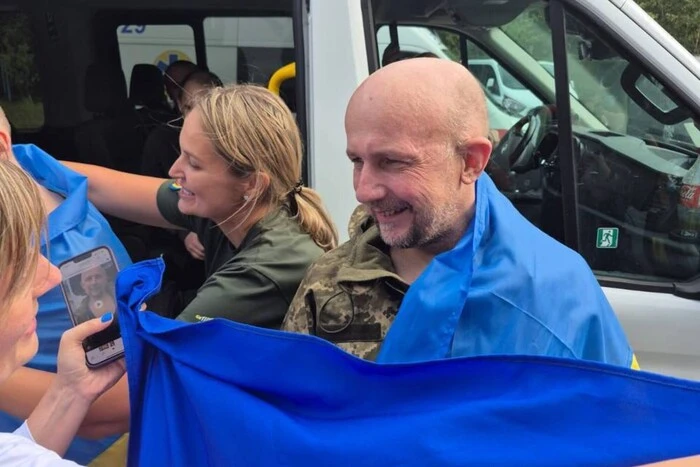
фото: Офіс президента
Journalist Dmitry Khlyuk, released from Russian captivity, is already adapting to normal life after his return. The information vacuum behind the scenes in the Russian Federation was absolute, news came only from the newly arrived. After his release, Khlyuk contacted the relatives of the prisoners to inform them that their loved ones were alive.
He told about this in an interview with “Pryamo”.
— First of all, I want to ask how you are feeling? I understand that as a man, as a journalist, you will say now – everything is great, everything is normal, but you have not been home for a long time. We know about the extremely difficult conditions you were in. How are you feeling now?
— I feel physically satisfied. There is a huge influx of information, everything is new, you have to get used to everything, you have to get used to normal life. I am adapting slowly.
— How strong was the information vacuum? Because, as far as I know, prisoners are not told much about what is happening in Ukraine, on the battlefield, no news, nothing. What reached you in captivity?
— The vacuum was complete. Nothing reached us, officially or unofficially, through prison staff. That is, we knew absolutely no information, not only about Ukraine, but in general, what was happening outside the window. The only source of information were people who were captured later, after 2022. If such a person ended up with one of the guys who have been in captivity since 2022, then we learned the news for the period when this person was captured.
— Not everyone is being replaced now, the boys and girls are staying there, and you are taking their information to Ukraine, to their loved ones. How is this process going now? Clearly someone wanted you to tell your family and friends. Are you contacting them?
— Yes, during these days when I was in the hospital, I called about 10-15 relatives of people who are in captivity. Both military and civilians, and people with whom I personally crossed paths in captivity at one time or another, in one year or another, and informed their relatives that their husbands, their brothers, their sons are in captivity, and they are alive. This is the main thing.
— What helped you hold on? Because none of us can even imagine what you went through, what you will probably keep hidden for a long time. Because, as a rule, they say that the whole truth about captivity is not told in order not to harm other prisoners. But you were broken in spirit, not physically broken. Are these some thoughts, memories? Or are you just such a strong person that this helped you?
— Actually, there are no other ways to stay there. We all sometimes told ourselves in the evenings that maybe we would be in captivity for a year, maybe two, maybe ten. And we told ourselves that even if it was ten years, we had no other way than to wait. And as for making it easier psychologically… We remembered home, remembered some of our lives, starting from childhood and ending with the times before captivity, who and how had been captured. We talked about the future, made hypotheses about what was happening in Ukraine now. We also had books in our cells. There were not many of them, not all of them were interesting, but books also helped to pass the time and distract from reality.
— It is clear that when Russian occupiers capture Ukrainian soldiers on the battlefield, you are a journalist. They were hunting ATO veterans, Ukrainian patriots. Didn’t you have the thought that maybe it was someone’s denunciation, someone’s tip-off, when you were captured? Obviously, there should be some kind of investigation into the circumstances of how you were captured. Have you already been interested in this, or talked to law enforcement about it?
— Regarding the first question – was it a tip-off? I have certain suspicions that it was a tip-off, because, indeed, the occupiers were interested in neutralizing, first of all, public activists, ATO participants. Perhaps I got on this list, perhaps someone reported it. But at the moment I have no evidence of this suspicion. But it is possible that at that time, at the beginning of the war, they took all men from 17 to 65 years old as an exchange fund, as hostages. Because practice showed then that they took anyone: whether you are a pensioner, or a factory worker, or a journalist, or a farmer. That is, they took everyone who came to hand.
We will remind, during the 68th prisoner exchange, which took place on Independence Day, it was possible to return to Ukraine military personnel and eight civilians who were illegally held in Russian captivity. Among the released are military personnel who were captured back in 2022. These are representatives of the airborne assault forces, air forces, naval forces, territorial defense, National Guard and State Border Guard Service. The youngest is 26 years old, the oldest is 62. Among the released is civilian journalist Dmytro Khylyuk, who was held in captivity for too long.
Also follow “Pryamim” on Facebook , Twitter , Telegram , and Instagram.