


Sky Justice: Ukrainian Drones Wreck Russian Radars and Oil Depots


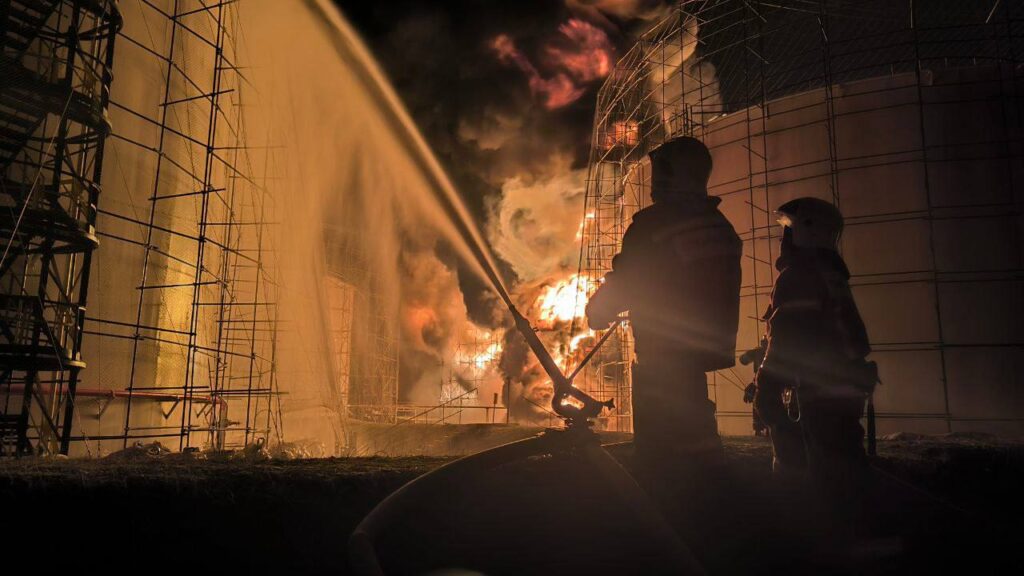
Ілюстративне фото
Ukrainian drones are hitting the Russian heartland with surgical precision — reaching targets up to 2,000 kilometers deep inside enemy territory. While the Kremlin keeps boasting about its “invincible defenses,” most of its air defense umbrellas are huddled around Moscow, leaving the rest of Russia exposed, humiliated, and burning.
Let me remind you that Ukrainian drones recently struck oil refineries in Ukhta and Tyumen — both nearly 2,000 kilometers from Ukraine.
The Russian dictator is well aware that Ukraine’s drones have not only extended their operational range, but also significantly improved their tactical and technical capabilities. Successful drone strikes against Russian air defense systems in both Crimea and inside Russia itself have exposed the complete helplessness of Moscow’s air defenses. At the same time, Russian radar systems are being systematically destroyed.
In just the past two weeks, the Ghosts, a special forces unit of Ukraine’s Main Intelligence Directorate (HUR), launched precision strikes against Russian air defense positions in Donbas.
According to HUR, during these operations, Ukrainian forces destroyed two 48Ya6-K1 Podliot radar stations and a 9A82 launcher from the S-300V surface-to-air missile system. As a bonus, the operatives sent a group of Russian soldiers — along with their KamAZ truck — to meet Kobzon.
These targeted strikes on Russian air defense infrastructure are paving the way for deeper and more effective attacks on strategic sites both inside Russia and in the temporarily occupied territories of Ukraine.
A telling confirmation of the impact of these operations is that, according to Russian sources, 38% of Russia’s oil refineries have either partially or completely shut down following Ukrainian drone strikes.
On the night of October 16, Ukraine’s Special Operations Forces hit the Saratov Oil Refinery in Russia’s Saratov region. One of the oldest refineries in Russia — once known as the Kreking Plant and now part of Rosneft — the Saratov facility had a refining capacity of 7.2 million tons in 2020, which had already fallen to 4.8 million tons by 2023.
Ukraine’s drones are not only reaching farther — they are rewriting the balance of power deep inside the aggressor’s territory..
Additionally, on the night of October 17, Ukraine’s Special Operations Forces (SOF) used strike drones to hit multiple enemy targets in the temporarily occupied territory of Crimea. The precise attacks destroyed an oil depot in the village of Gvardeyskoye and the Gvardeysky Combine industrial site in Karyernoye, Saky District.
Ten days later, on the night of October 27, SOF units carried out another series of successful drone strikes — this time against Russian supply facilities in the occupied Luhansk region. According to the SOF press service, Ukrainian special forces struck a fuel and lubricants train in Starobelsk and an oil depot in Luhansk. Notably, the drones hit the train at the exact moment the tanks were being filled, maximizing the blast impact — a tactical move Ukrainian operators call the “strike front” effect.
Meanwhile, the consequences for Russia’s air defense are becoming increasingly visible. Following a wave of successful Ukrainian UAV attacks, air defense systems from northern Russia are being redeployed to the Moscow region, leaving other areas exposed.
Among them are Arctic Tor missile systems, spotted near Moscow to create the illusion of a “layered” defense. A recently published map of air defense deployments in and around the capital shows an emergency concentration of S-300, S-400, Pantsir, and Tor systems — essentially everything the Kremlin could scrape together from across its vast territory.
The reality, however, is stark: Russia’s military-industrial complex has severely limited capacity to produce new air defense systems.
This is confirmed by Moscow’s own moves. Russia has reportedly offered to buy back its S-400 systems previously sold to Turkey, and has once again extended its contract with India for S-400 deliveries until 2027. The original contract envisioned five systems by 2023 — a deadline now missed by four years.
All this makes clear that Putin’s boasts about “round-the-clock” weapons production are little more than political theater. On the battlefield and in the air, Ukrainian technology is proving far more dynamic — and Russia’s “four-shift miracle” of rearmament remains pure fiction.
Also follow, “Pryamyi” on Facebook, Twitter, Telegram, and Instagram.
• Materials published in the “THOUGHTS” section reflect the opinion of the author of the publication, who bears full responsibility for the accuracy of the information.
• The editorial board of prm.ua may not share the opinions expressed in the author’s material.
• The owner of the web page in the “THOUGHTS” section is the author of the publication.