


Monument to the ‘RuskiyMir’: Why Bulgakov Is Back in the Spotlight


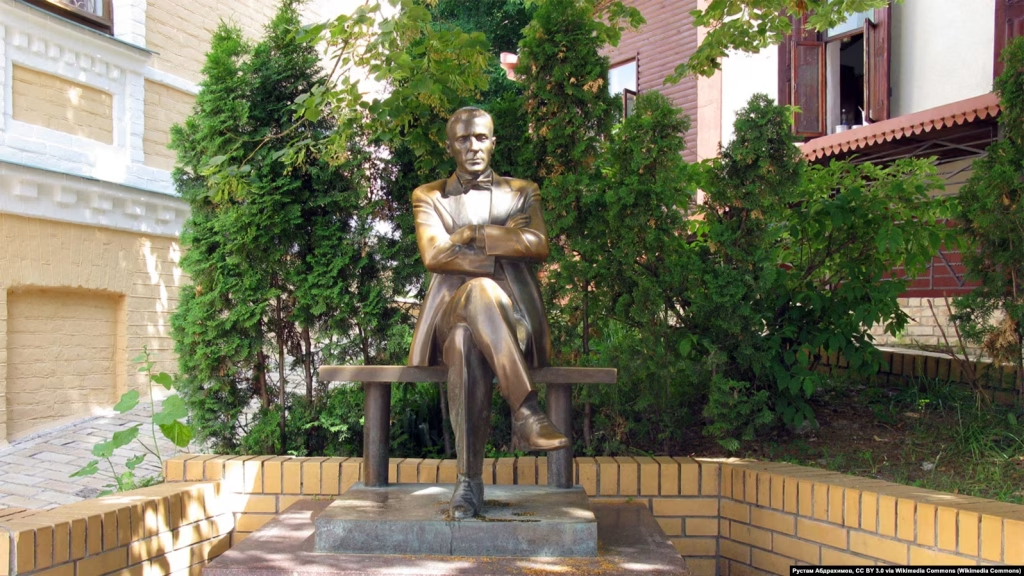
фото з відкритих джерел
Source: Author’s Facebook page
This discussion about monuments is unusual. Until 2007, there was no monument to Bulgakov—not in Kyiv, not in Moscow, nor anywhere else.
In 2007, the idea of erecting a monument was supported by Chernovetsky and the Russian embassy, and it was financed by Denis Bass, a member of Chernovetsky’s team who was accused of stealing Kyiv land, fled to Moscow, and became a Russian developer.
So, whether there is a monument on the descent, Bulgakov’s “defenders” have never been spared criticism. Bulgakov himself would likely have laughed at such defenders — not with the laughter of the Master, but with Voland’s. This talented Russian, born in Kyiv, never sought to be considered a Ukrainian writer. He remained a “good Russian” of his time and, in The White Guard, depicted quarrels among the good Russians of that era — just as he could now describe conflicts between Yulia Navalny and Nevzlin, or between Kasparov and Kara-Murza.
I believe that if a modern Bulgakov were to write something similar, Putin would appreciate it, just as Stalin admired The White Guard. The flawed “good Russians” lose, fight among themselves, and look down on Ukrainians.
But why is there a monument in Kyiv? Why is Ukraine involved in this?
General Zabrodsky and I once delivered to the front wonderful pocket editions of Kobzar, published by the Kyiv-based publisher Spirit and Letter for soldiers. We did not bring The White Guard. That would have been strange, of course. But it is easy to imagine a copy of Bulgakov in the aggressor’s backpack.
Because, while we can research and read everything, monuments are another matter. They are erected for those who are loved in this world, for those who love their people.
Myron Petrovsky has preserved the memory of the talented writer Bulgakov, most effectively in his deeply humanistic book about the author and the city of Kyiv. Meanwhile, the monument’s creator and the sculptor’s family can keep their lovingly crafted work on private property.
However, the defenders of the Bulgakov monument in central Kyiv are not truly defending him; they are defending the “Russian world” that the author of The Master and Margarita admired — a world his supporters cherish, seemingly unaware that it is already causing real harm to us.
As a reminder, on December 18, at a plenary session of the Kyiv City Council, deputies supported the decision to remove 15 objects and individual elements related to the history and symbolism of Russian imperial and Soviet policy from the public space of the capital.
Monuments to Mikhail Glinka and Anna Akhmatova, the symbolic “Kyiv – Hero City” sign with a five-pointed star, a memorial stone commemorating Lenin’s 100th anniversary, a plaque honouring Pyotr Tchaikovsky, and other objects will be dismantled or replaced. The decision to remove the bronze monument to Mikhail Bulgakov caused the greatest resonance on social media. It was installed in 2007 on Andriyivskyi Uzviz, next to the writer’s museum — the Turbin House.
Also, follow “Pryamiyi” on Facebook, Twitter, Telegram, and Instagram.
• Materials published in the “OPINIONS” section reflect the opinion of the author of the publication, who bears full responsibility for the accuracy of the information.
• The editorial staff of prm.ua may not share the opinions expressed in the author’s material.
• The owner of the webpage in the “OPINIONS” section is the author of the publication.