


Mysterious “trees” on Mars: what was captured in the NASA probe’s image


Фото з відкритих джерел
An unusual formation has appeared in images of the Martian surface, which from a distance resembles a dark forest in the middle of snow-covered dunes. The bizarre pattern was captured by NASA’s Mars Reconnaissance Orbiter. Despite its resemblance to vegetation, the unusual appearance of the landscape is explained by seasonal processes related to the freezing and evaporation of carbon dioxide.
This is reported by ScienceAlert.The dark lines in the photograph are located on sand dunes near the planet’s north pole. Their branched shape creates the illusion of trees seemingly growing through the icy surface. If the image’s orientation is changed, it becomes noticeable that these are not separate objects, but traces of sand that has shifted along the slopes of the dunes.
The appearance of such patterns is related to the specificities of the Martian winter and spring. During the cold period, carbon dioxide from the atmosphere settles on the surface and freezes. This forms a layer of dry ice that covers the polar regions and sand dunes.
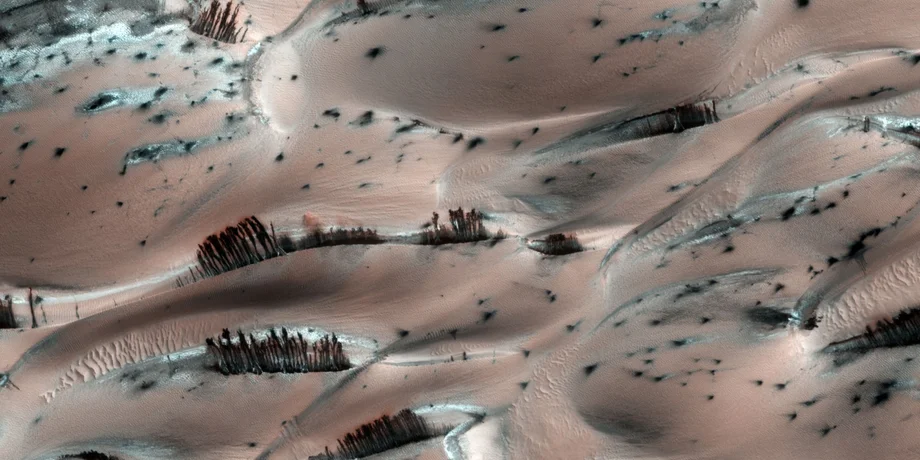
In the spring, when the temperature rises, the reverse process begins. Instead of melting, the dry ice turns directly into gas. This phenomenon is called sublimation.During this process, sunlight passes through the ice crust and heats the dark sand beneath it. Gas gradually accumulates, and when the pressure becomes sufficient, it breaks through to the outside. Along with it, particles of sand are ejected onto the surface, spreading across the slopes.
This is exactly how the dark streaks resembling branches and tree trunks arise. Their appearance depends on the movement of the sand and the features of the dune surface.
During the summer, the dry ice disappears, and the dark patterns gradually cease to stand out on the surface. With the onset of the next winter, the dunes are covered once again with frozen carbon dioxide, and the seasonal process repeats. Thus, the Martian “forest” is not a sign of vegetation, but the result of the interaction of solar heat, gas, and sand.