


“Russian World” is a world of shit


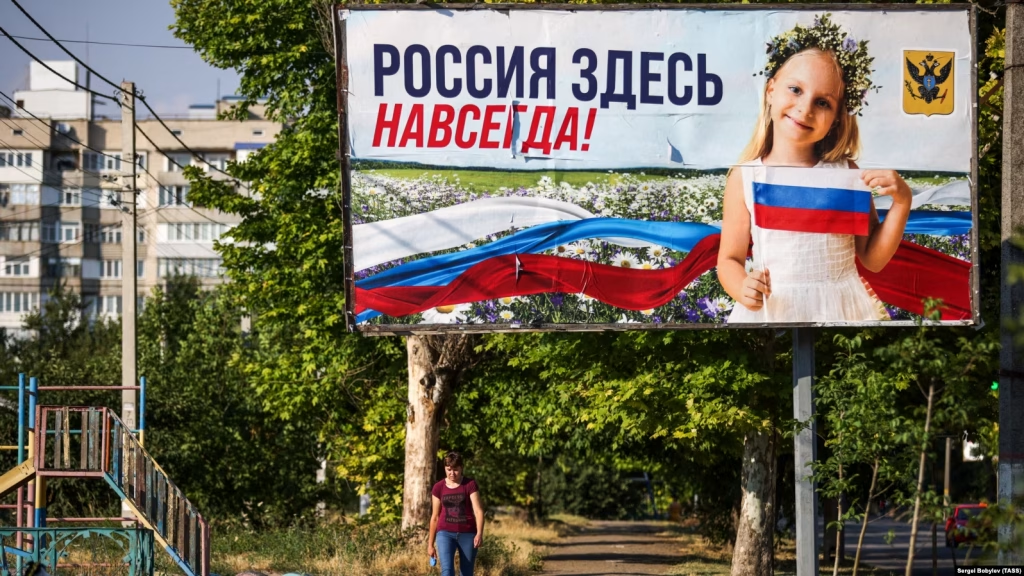
фото: росЗМІ
Source: Author’s Facebook page
This is not an emotional, but a practical assessment based on real facts.
As you know, there is no water in the temporarily occupied territories. This problem has already spread to the areas of Zaporizhzhia region not controlled by Ukraine (where no one expected the “Russian peace”), but it is especially severe in the Donetsk region. In Mariupol, Donetsk and other captured cities of Donbas.
There will be no water in the occupied territories. There will be no water! Simply because there is nowhere for it to come from.
“Russky Mir” blew up the dam of the Kakhovka hydroelectric power station, as a result of which the Kakhovka reservoir dried up.
It was from this reservoir that Dnieper water flowed to Berdyansk, Prymorsk, and other settlements in the Ukrainian Azov region occupied by the Russians.
Then the rivers dry up, the water from artesian wells disappears. In the Zaporizhia region – that part of it where, unfortunately, the Russians farm, the restrictions are already being felt.
In Donetsk, things have gone much further. As a result of the fighting, the water mains that brought water to the city have been cut. This problem cannot be solved immediately, even if the war ends tomorrow. And the war was brought about by the “Russian world”, which, unfortunately, has settled very firmly, like a cancerous tumor, in the Donbas.
Water is supplied on a schedule of once every 3 days – and this frequency is very often not adhered to.
The water that is still served is not suitable for drinking or for technical needs. Blessed Z-military officer, champion of the “Russian world”, Dmitry Steshin, having tasted the healing Donetsk water (he became a goat), almost lost his sight. He caught acanthamoebic keratitis – amoebas penetrated his body and began to devour the cornea of his eyes.
To extract at least this much water, people have to stand guard near the basements of their homes, because the pressure in the system is simply not enough to lift it above the basements.
It is clear that in such conditions you can forget about sewage and water closets. People defecate in bags and then throw feces on the streets. The locals themselves admit that Donetsk has turned from a city of a thousand roses into a city of shit.
This is what the inhabitants of the cities of the Middle Ages did. They threw shit and filth right into the streets. But one thing is the Middle Ages, and another thing is Donetsk. A city that until recently was the industrial capital of Ukraine, a real European metropolis. Donetsk hosted matches of the Champions League and Euro 2012. The streets of this city were so clean that it seemed as if they were being cleaned by hand, sparing no detergents. As diligently as we wash the floor in our own apartment.
What will happen next? Medieval cities, whose residents dumped waste products on the streets, always suffered from unsanitary conditions. As a result, rodents began to breed. In particular, rats, which are carriers of the bubonic plague.
Plague, cholera, dysentery, hepatitis A, typhus and other delights of the Middle Ages are exactly what sooner or later awaits the occupied territories. If there is no water, then dirt is bred. And with it come diseases, infections and epidemics. There are no other options. Dirt, death, destruction and a return to the Middle Ages. That is what the Russian occupation brings in its wake.
Now you understand why the “Russian world” is a world of shit. Everyone who finds themselves in the “Russian world” will be immersed in this shit up to their ears. In the literal sense of the word.
Also follow “Pryamim” on Facebook , Twitter , Telegram , and Instagram.
• Materials published in the “OPINIONS” section reflect the opinion of the author of the publication, who bears full responsibility for the accuracy of the information.
• The editorial staff of prm.ua may not share the opinions expressed in the author’s material.
• The owner of the webpage in the “OPINIONS” section is the author of the publication.