


Hit the Refineries, Starve the War: How Oil Strikes Undercut the Kremlin


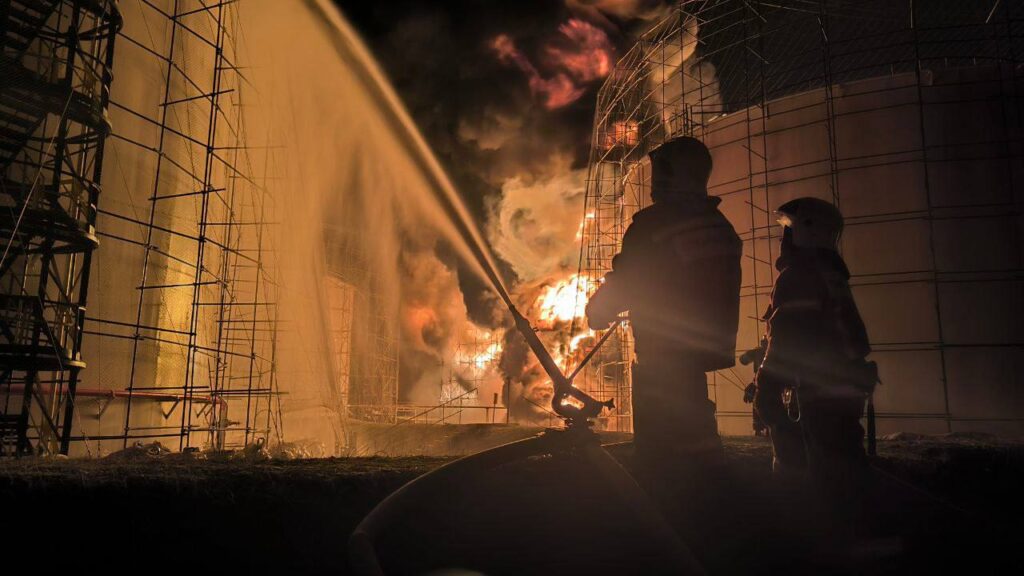
Ілюстративне фото
Attacks on Russia’s oil refining infrastructure have emerged as one of the defining developments of 2025. Through a series of strategic strikes, Ukraine has turned the Russian oil industry into a critical vulnerability, already affecting the course of the war and creating long-term challenges for the Kremlin in fuel supplies, exports, and military financing.
In November 2025 alone, 41 strikes were carried out against legitimate military targets on the territory of the occupying country, using both attack drones and ballistic missiles. These included stationary targets such as military-industrial facilities and Russian oil refineries.
Ukraine’s concentrated campaign against oil refining had tangible economic consequences for Russia. Domestic petrol and diesel prices rose, fuel supply disruptions occurred, and oil companies incurred multibillion-dollar losses. At the same time, export volumes and budget revenues declined, undermining the Kremlin’s ability to sustain the war.
“Ukrainian strikes on oil refineries have inflicted more damage on the Russian economy than many Western sanctions packages. This is a direct blow to the revenues that finance the war,” said Kyrylo Budanov, former head of Ukraine’s Main Intelligence Directorate.
Ukrainian military intelligence emphasises that the attacks on oil infrastructure target the core of the Russian economy, rather than peripheral sectors. The objective is not only short-term disruption, but a long-term degradation of Russia’s capacity to wage large-scale military campaigns
“In fact, our strikes have had a greater impact than sanctions — it is simply a matter of mathematics. We have inflicted far greater damage on Russia’s profits through direct action than through any economic leverage applied so far,” said Kyrylo Budanov.
Oil refining is a critical component of the military fuel supply chain, meaning that strikes on refineries directly affect the combat readiness of Russian forces. Reduced refining capacity and disruptions to fuel logistics constrain equipment movement, limit the intensity of operations, and increase the cost of sustaining Russian troop deployments. Without a stable fuel supply, large-scale offensive operations become impossible.
The Ukrainian command also stresses that targets are selected to minimise risks to civilians and to focus exclusively on military and paramilitary infrastructure. These include oil refineries, bases, terminals, and facilities directly linked to military logistics and the financing of Russia’s war effort.
Over the past few months, Ukrainian drones have struck several oil refineries across European Russia, including:
-
the Syzran Oil Refinery;
-
the Volgograd Oil Refinery;
-
the Saratov Oil Refinery;
-
the Ukhta Oil Refinery;
-
the Samara Oil Refinery, located roughly 1,000 km from Ukraine;
-
the Krasnodar Oil Refinery;
-
the Ryazan Oil Refinery;
-
the Afipsky Oil Refinery;
-
the Ilsky Oil Refinery;
-
the Ufa Oil Refinery.
The consequences of these attacks can be inferred from statements made by the Russian authorities themselves. The decision to raise VAT from 20 to 22 per cent is particularly telling. It suggests that the Russian budget is increasingly strained and no longer has sufficient resources to sustain high-intensity military operations in Ukraine.
Roughly a third of Russia’s federal budget revenue comes from petrodollars, making the effectiveness of strikes on oil refineries particularly significant.
A second indicator is Russia’s 2026 budget. According to Russian economists, planned expenditures have been increased by around 4 per cent of GDP — roughly $1 trillion — funds that, in practical terms, are no longer available within the existing budget framework.
By Russia’s own estimates, budget losses resulting from Ukrainian drone and ballistic missile strikes on oil refineries amount to approximately $100 billion.
Following the imposition of sanctions on Rosneft and Lukoil, combined with successful Ukrainian attacks on oil refineries and terminals, Russia has been forced to sell oil and petroleum products at record discounts of up to 40 per cent.
Even more telling is the fact that, despite such discounts, major buyers have begun to turn away Indian purchasers; for example, they have reportedly refused to buy Russian oil, instead discussing supply diversification, including increased imports from Saudi Arabia and other producers. A similar pattern is emerging in China, where refineries appear unwilling to risk purchasing Russian oil even at steeply discounted prices.
The strikes on oil refineries have also directly affected Russia’s military budget and funding for programmes supporting participants in the so-called “special military operation”. In the Republic of Sakha (Yakutia), for instance, local authorities have announced the suspension of payments to participants, officially citing a lack of funds. This development is directly linked to Ukrainian strikes on oil facilities in the region, carried out by drones operated by Ukraine’s military intelligence — targets located more than 2,000 kilometres from Ukrainian territory.
As a result, Russia now faces a fundamental question about the future of its oil refining sector. There are no more than 40 oil refineries in the country, and according to Russian estimates, around 40 per cent of them have either partially or completely halted production.
The fate of the Ryazan Oil Refinery — one of Russia’s most technologically advanced facilities — is particularly illustrative. After undergoing three rounds of modernisation using Western technology, the refinery announced the suspension of operations following Ukrainian drone strikes. The facility had been a key supplier of fuel and lubricants to Moscow and the surrounding region.
At the same time, it supplies fuel and lubricants not only to Moscow and the surrounding region, but primarily to the Russian army. This creates direct logistical problems for the occupation forces.
Now let’s look at the results of the successful strike by Ukrainian Defence Forces’ naval drones on the Novorossiysk oil terminal, which handles approximately 5% of the world’s oil. The consequences for Russia are simply catastrophic. Moreover, the Russian side stated that the oil terminal in question cannot be restored after the attack. This is the most serious blow to Russia’s ability to supply oil to end consumers.
It’s also telling that the actions of the Ukrainian defence forces are in sync with US efforts to reduce the potential for the use of the shadow fleet. For example, thanks to US diplomatic and economic pressure, Panama and the Bahamas refused to allow the Russian shadow fleet to fly their flags. As a result, more than 500 “rusty troughs,” as Russia itself calls them, are moored, unable to transport oil and petroleum products. This is the most serious blow to Russia’s ability to replenish its treasury with petrodollars.
Notably, 2025 proved to be a disastrous year for the Russian Federation, particularly given its foreign policy as a “gas station nation.” The State Duma suspended petrol and diesel fuel exports to stabilise the domestic situation. Russia was forced to take unpopular measures, including increasing petrol and diesel fuel imports, which it sourced from Tatarstan and Belarus.
As a reminder, drones attacked the Russian city of Syzran on the night of December 28. The strike could have hit an oil refinery and electrical substations.
As reported, on the night of December 26, residents of Volgograd, Russia, reported a series of loud explosions in various parts of the city. According to preliminary information, the local Lukoil-Volgogradneftepererabotka oil refinery was hit again, causing a massive fire after the attack.
Also, follow “Pryamyi” on Facebook, Twitter, Telegram and Instagram.
• Materials published in the “THOUGHTS” section reflect the opinion of the author of the publication, who bears full responsibility for the accuracy of the information.
• The editorial board of prm.ua may not share the opinions expressed in the author’s material.
• The owner of the web page in the “THOUGHTS” section is the author of the publication.