


The Guardian investigation: Zaluzhny secretly prepared for a full-scale invasion from Zelensky


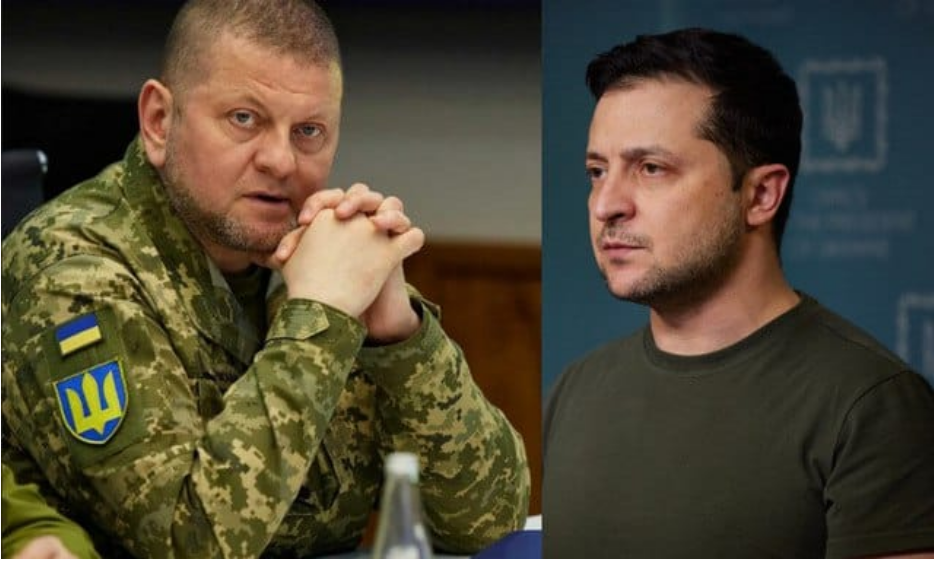
Valeriy Zaluzhny was disappointed that Zelensky did not want to impose martial law. Since the fall of 2021, American and British intelligence had been warning Europe and Kyiv about the scale of the possible invasion, but the Ukrainian authorities, France, and Germany refused to believe in the attack.
This is stated in a large-scale investigation by the British newspaper The Guardian.
In the first half of January, the Americans received more detailed information about the plans: Russian troops were to invade Ukraine from several directions, including Belarus, airborne forces were to land at Gostomel airport near Kyiv to organize the capture of the capital, and there was also a plan to assassinate Zelensky.
Preparations for the ground game after the invasion also continued, with lists being drawn up of “problematic” pro-Ukrainian figures who were to be interned or executed, and pro-Russian figures who were to be involved in the governance of Ukraine.
Burns flew to Kyiv to personally brief the Ukrainian president on what the CIA feared was coming, but the reaction was not what he had hoped for. A week later, Zelensky released a video message to Ukrainians urging them not to listen to those who predicted conflict. He said that Ukrainians would grill meat on their barbecues in the summer, as usual, insisting that he “sincerely believes” that there would be no major war in 2022.
“Take a deep breath, calm down, and don’t run around stocking up on food and matches,” he told the population.
It was disastrous advice, given that many thousands of people would soon find themselves trapped in an active conflict zone or under Russian occupation. Even days before the invasion in February 2022, Zelensky publicly denied the threat, the publication writes.
The Commander-in-Chief of the Armed Forces of Ukraine, Valeriy Zaluzhny, was disappointed that Zelenskyy did not want to impose martial law, which would allow him to redeploy troops and prepare battle plans.
“You’re going to fight Mike Tyson, and the only fight you’ve ever had before is a pillow fight with your little brother. It’s a one in a million chance, and you need to be ready,” he said.
Without official approval, Zaluzhny did what little planning he could afford. In mid-January, he and his wife moved from their ground-floor apartment to his official quarters in the General Staff complex for security reasons and so that he could work longer hours.
In February, another general recalled, there were exercises among the army’s top brass to plan for various invasion scenarios. These included an attack on Kyiv and even one that was worse than what eventually happened, when the Russians seized a corridor along Ukraine’s western border to cut off supplies from the Allies. But without a sanction from above, these plans remained only on paper; any major troop movement would be illegal and difficult to disguise.
Ukrainian interlocutors said that Zelensky did not believe in the invasion because he was convinced of it by the head of the OP, Andriy Yermak. He often communicated with Putin’s deputy head of the administration, Dmitry Kozak, as part of the long negotiations on Donbas.
So, on February 22, 2022, the National Security and Defense Council met in Kyiv. Zaluzhny tried to enlist support for the introduction of martial law, which would finally allow him to begin the transfer of troops. He was supported by Reznikov, the Minister of Defense. But Zelensky was still worried that he might sow panic, and the Rada rejected martial law, voting for the less significant measure of the introduction of a state of emergency.
On the final evening before the attack, at Ukrainian army headquarters, Zaluzhny and his top generals attempted to take some last-minute measures. Mines were laid on the bottom of the Black Sea to prevent a potential naval landing at Odessa, and some units were ordered to be relocated to more strategically important locations.
“All of this was completely forbidden. If the invasion had not happened, there would have been a possibility of lawsuits against us for it, but most commanders recognized that we had no choice and carried it out,” said one general.
Recall that Petro Poroshenko previously stated that President Volodymyr Zelensky should immediately convene the National Security and Defense Council with the participation of the leaders of parliamentary factions.
The day before, he emphasized that the Verkhovna Rada should hold a meeting to discuss the situation related to the likelihood of Russia launching full-scale military actions against Ukraine.
Earlier, during the International Security Conference in Halifax, the fifth President Petro Poroshenko called on allies to provide Ukraine with more lethal defensive weapons.
Also follow “Pryamim” on Facebook , X , Telegram , and Instagram.