


The Price of Maritime Paralysis: How the Black Sea and Sea of Azov Blockade Is Strangling Russia’s Exports


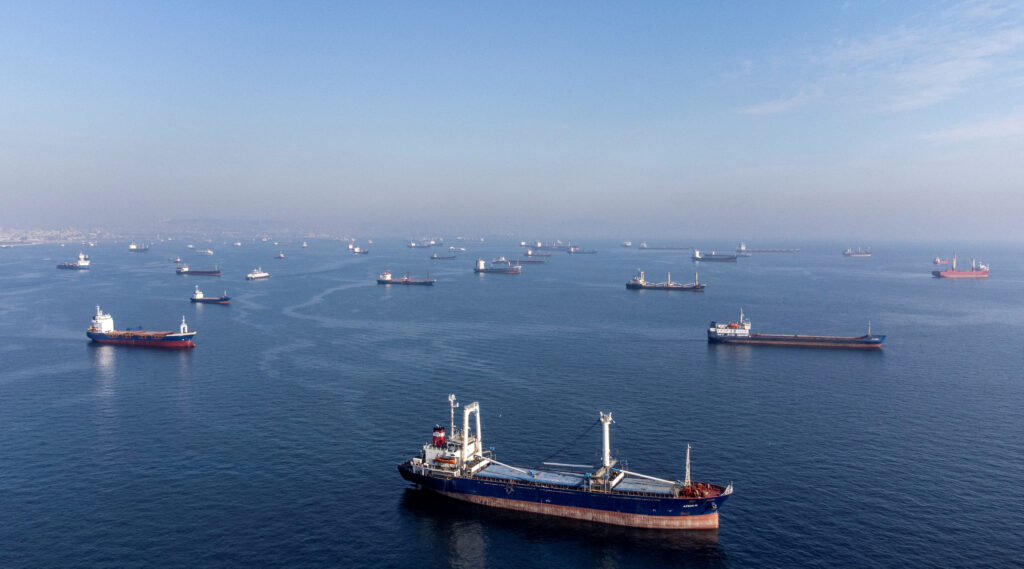
фото: Reuters
Ukraine’s campaign of blockades and systematic strikes on Russian facilities in the Sea of Azov has paralyzed Russia’s maritime logistics, causing serious economic and infrastructure problems. The suspension of navigation through the Kerch Strait and attacks on transport vessels have disrupted key Russian export routes at the height of the harvesting season.
A significant loss for the occupiers was the blockade of deep-water ports in the Sea of Azov. In particular, Berdyansk, which the Russian Federation used as one of the key ports for the logistical support of the occupation army. In addition, grain crops harvested in the occupied Zaporizhzhia and Donetsk regions were shipped through this port.
In addition to agricultural products, heavy metallurgy products, and mineral fertilizers. The occupiers recognize the fact that as a result of attacks by Ukrainian UAVs on dry cargo ships and barges, Russian grain exports have decreased by almost 30%. This is a colossal undersupply to the Russian budget.
The strikes by the Ukrainian Defense Forces on Russian transport infrastructure have significantly complicated the export of Russian agricultural products, leading to multi-billion dollar losses for the Russian budget.
This concerns the blockade of the Sea of Azov, which the Russians mistakenly consider to be an internal sea of the Russian Federation, as well as a serious restriction on the supply of Russian crude oil through the Bosphorus and the Dardanelles to end consumers. I focus on crude oil because, after strikes by the Ukrainian Defense Forces on oil refineries, Russia has largely lost the ability to process crude and produce gasoline and diesel.
As a result, the supply of petroleum products to end consumers has become extremely complicated. Therefore, the Kremlin is trying to offset catastrophic budget losses by exporting crude oil. However, as we see, this strategy is not giving the desired result either.
It is worth noting that in July, as a result of systematic attacks by the Armed Forces of Ukraine on Russian infrastructure and tankers in the Black and Azov Seas, the transportation of Russian oil products decreased by 45.6% compared to June. Shipments of oil products from the ports of the Sea of Azov (including the ports of the Volga and Don rivers) decreased by 64.3%, or 2.8 times. In the Black Sea, Russian crude oil exports decreased by 18.1% in July.
As a reminder, the occupying country imposed a ban on diesel fuel exports from July 8 to 31 as part of a broader package of measures to support the domestic fuel market. Subsequently, the Russian government extended the ban on gasoline exports until January 31, 2027, and on diesel exports until August 31, 2026.
Historically, Russia itself is one of the largest exporters of diesel. About 40-50% of the fuel produced was exported abroad. For example, in 2023, domestic consumption of diesel amounted to 52.2 million tons, with 35.7 million tons exported.
However, the strikes on refineries, which have reduced oil refining in Russia to 20-year lows, have cut diesel output by almost 40%—more than gasoline, which has fallen by a quarter.
Ukrainian drones have effectively blocked the movement of Russian dry cargo and bulk carriers in the Black Sea. Moreover, the intensity of these strikes is constantly increasing. The occupiers are forced to admit that the Sea of Azov is effectively blocked, and the transportation of oil through the Black Sea is in serious doubt. In addition, the Don-Azov Canal has been blocked. All this means the most serious losses for the Russian budget.
The navigation stoppage is forcing the Russian Ministry of Transport to seek alternative railway routes, sharply increasing logistics costs and leading to direct losses for producers amid the filling of domestic storage facilities.
In turn, the destruction of the Ukrainian defense forces of the tanker fleet has made it impossible to export Russian oil products through the Sea of Azov. The damaged vessels, which are drifting and require towing, have blocked traffic, making it difficult to supply fuel and military cargo to the occupied peninsula.
An attempt to redirect flows to ports such as Novorossiysk causes an infrastructure collapse, as the rail network and terminals are not designed for an emergency doubling of volumes.
The negative consequences for Russians also extend to the agricultural sector.
Due to the high risk of ships being destroyed, the Russian authorities temporarily suspended applications for passage through the Kerch Strait, thereby completely blocking the Don-Azov route. It is worth noting that the occupying country exported about 27–30% of its grain (over 14 million tons per season) via this route. Due to the blockade, Russian grain exports in July fell to their lowest level since 2017.
IKAR analysts recorded a 20% drop in grain exports from the planned level (to 2 million tons instead of 2.5 million tons) due to logistical paralysis. This means a corresponding decrease in foreign exchange earnings from the sale of agricultural products on world markets. And, as the Russians themselves like to say, “We haven’t even started yet.” This is about further increasing the intensity of Ukrainian strikes.
I would like to note that the Russian air defense system is struggling to cope with the growing number of attacks. The enemy is forced to admit that the possibilities to counter Ukrainian attacks are actually minimal. The enemy’s air defense system is inefficient, while the number and quality of Ukrainian strikes are steadily increasing.
Also, follow “Pryamyi” on Facebook, X, Telegram, and Instagram.
• Materials published in the “OPINIONS” section reflect the opinion of the author of the publication, who bears full responsibility for the accuracy of the information.
• The editorial staff of prm.ua may not share the opinions expressed in the author’s material.
• The owner of the webpage in the “OPINIONS” section is the author of the publication.