


Six Months of Bromance: Putin’s Apprentice and the Miniature Dictator’s Handbook


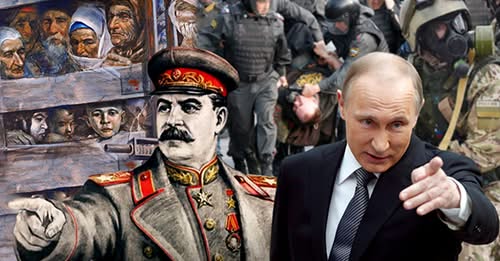
фотоколаж: zbruc.eu
Source: Author’s Facebook page
Vladimir Putin could have become the most fortunate ruler in modern Russian history — and perhaps of the entire first quarter of the 21st century. By a twist of fate, and without any particular merit, he inherited control over a country rich in natural resources, with a sizable and relatively youthful population in 1999, and a vast sphere of untapped soft power in its geopolitical orbit.
In addition, Putin inherited an economy that had already undergone substantial market reforms. In this regard, Russia was significantly ahead of Ukraine and other neighboring countries in terms of de-Sovietization.
The conditions were exceptionally favorable: a stable upward trend in resource prices, open access to European markets, the rapidly growing Chinese market, and exclusive access to the markets of neighboring states. Following the shift in U.S. foreign policy after the September 11, 2001, attacks, Russia acquired a unique position — a partner of the United States, while simultaneously maintaining strong influence in the Middle East, Central Asia, and Central Europe.
All that remained was to build a “Canada+”: a country perhaps somewhat less democratic, but with the added advantage of its sphere of cultural and economic influence.
However, this path required a personal concession — the rejection of the role of a kleptocratic ruler. At a minimum, it demanded respect for neighbors, the ability to negotiate rather than dominate; it implied the necessity to engage in sincere dialogue and honest negotiations even with so-called “junior” partners.
Yet throughout his entire journey, Putin was constrained by his complexes and his aspiration not to be compared with leaders like Konrad Adenauer or Park Chung-hee, but rather with tyrants such as Peter I or Stalin — albeit with a palace in Sochi. This contempt, arrogance, and desire for immediate dominance were reflected in his interactions with the equally ego-driven U.S. president.
When Putin was again exceptionally fortunate and achieved a political victory without a battlefield triumph, it appeared to him as if he had seized divine favor.
If Putin once relied on his country’s resource advantage and the vulnerability of democratic mechanisms to direct pressure, the situation has now changed. After three and a half years of a futile war against Ukraine and 25 years of the most corrupt regime in history, his position has significantly weakened. Opposite him stands a man with an equally inflated ego.
Will he be fortunate again? Will he manage to “slip through” this time? His regime and economy are already under severe strain, and a relatively small push could be sufficient to destabilize them.
The trajectory of his downfall is clear — it is only a matter of time. The sooner this regime collapses, the sooner the world will breathe a sigh of relief, and Ukraine will secure its ultimate victory.
Also, follow “Pryamyi” on Facebook, Twitter, Telegram, and Instagram.
• Materials published in the “OPINIONS” section reflect the opinion of the author of the publication, who bears full responsibility for the accuracy of the information.
• The editorial staff of prm.ua may not share the opinions expressed in the author’s material.
• The owner of the webpage in the “OPINIONS” section is the author of the publication.