


Ukraine received Phantom MK-1 humanoid robots for testing at the front: what will they be used for?


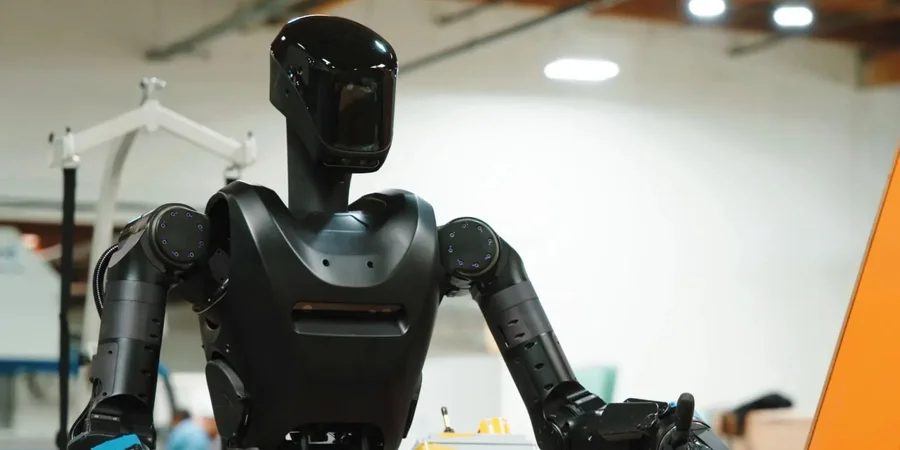
Фото: foundation
Ukraine has received 2 Phantom MK-1 humanoid robots to evaluate their effectiveness in combat conditions. The robots are planned to be used primarily for reconnaissance missions on the front line.
This is reported by Time .
The Phantom MK-1 humanoid robot is designed as a system capable of performing combat missions in a format similar to human actions. The robot has the appearance of a soldier in a black metal body with a tinted glass visor and can use various types of small arms, including a revolver, a pistol, a shotgun and a replica of an M-16 rifle.
Foundation co-founder Mike LeBlanc, a 14-year U.S. Marine Corps veteran, explained that the concept allows the robot to use any weapon available to a human.
“We believe there is a moral imperative to use these robots in war instead of soldiers ,” said Mike LeBlanc.
According to him, the developers’ goal is for the robot to be able to use any weapon that a person can use.
The Phantom is currently undergoing testing at facilities in countries from Atlanta to Singapore. It is billed as the world’s first humanoid robot designed specifically for defense use. Foundation already has $24 million in research contracts with the U.S. Army, Navy, and Air Force.
In February, 2 Phantom robots were transferred to Ukraine . Initially, they are planned to be used for reconnaissance on the front lines.
LeBlanc notes that humanoid robots could be an extension of autonomous systems such as drones. According to him, the robots do not feel fatigue or fear and are able to work continuously even in difficult conditions, including environments with radiation, chemical or biological contamination.
At the same time, there is debate surrounding the use of such systems. Critics point out that humanoid robots can lower the political and ethical barriers to starting conflicts, as well as complicate the issue of liability in case of violations.
Current Pentagon protocols state that automated systems can only use force with human authorization, and the Foundation says it plans to apply a similar principle to the Phantom system.
At the same time, drones with artificial intelligence are already being actively used in the war in Ukraine , capable of identifying targets and opening fire autonomously in cases where Russian electronic warfare means make remote control impossible.
“This is a full-scale robot war, where the robot is the main fighter, and humans only provide support. This is the complete opposite of what was during my service in Afghanistan,” said Mike LeBlanc.
Ukraine is reportedly launching up to 9,000 drones every day, making the country a major testing ground for new military technologies. Many companies are seeking to automate elements of the so-called “chain of destruction,” which involves detecting, identifying, and engaging a target.
However, experts are drawing attention to the risks of using humanoid robots. Pralad Wadakkepat, an associate professor at the National University of Singapore, notes that the complex mechanics of such systems can create additional threats.
“If you fall next to a baby, you know how to land without causing harm. Can a humanoid do the same?” said Pralad Vadakkepat.
Other risks include the possibility of software failures, system capture by the enemy, or difficulties in assessing complex situations on the battlefield.
Roboticist and philosopher Peter Asaro emphasizes that the use of autonomous combat systems raises questions of responsibility.
“This is a question of human dignity. These machines are not moral or legal agents, and they will never understand the ethical consequences of their actions,” said Peter Asaro.
The developers also acknowledge that the technology needs further improvement. Robots can crash or malfunction during testing.
The next version of the Phantom MK-2 system, according to the company, should appear in April. It should receive updated electronics, a waterproof case, increased batteries and the ability to carry loads weighing up to 79 kg. It is also planned to optimize production to produce up to 30,000 robots per year in the future.
Recall that the ground robot of the Third Army Corps independently held its position at the front for a month and a half and restrained attacks by Russian troops without the participation of infantry.
Also follow “Pryamim” on Facebook , X , Telegram , and Instagram.