


40 Years After Chornobyl: A Catastrophe We’re Still Not Taking Seriously


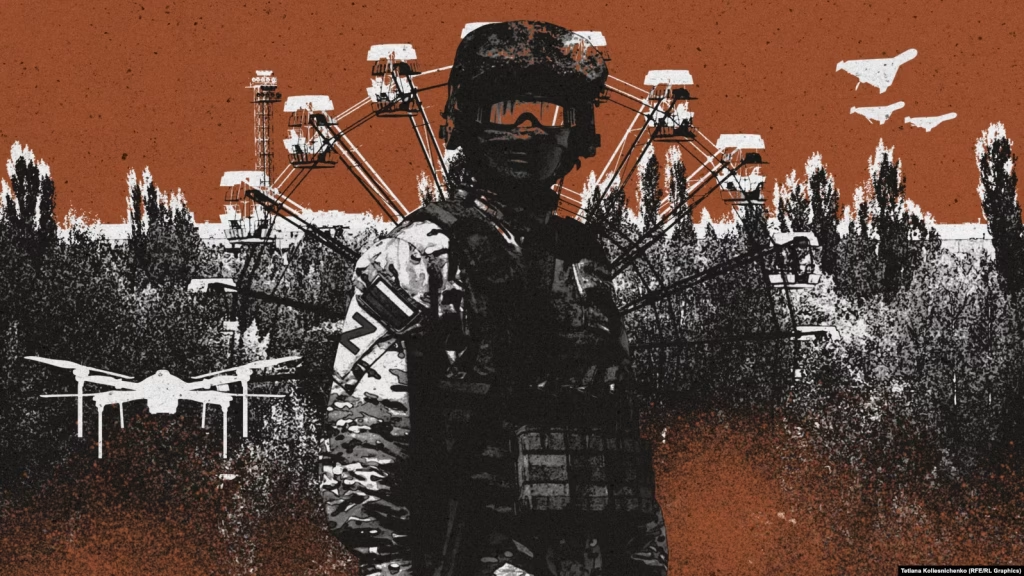
фотоколаж: Радіо Свобода
Source: Author’s Facebook page
On the 40th anniversary of the Chornobyl tragedy, we are forced to admit the bitter truth: the world has not drawn the proper conclusions. While Ukraine honors the memory of the liquidators, the Russian aggressors continue to cynically “play with fire” at the captured Zaporizhzhia NPP.
The occupiers are not just blackmailing the world—they are already crossing the line: a Russian drone damaged the new confinement (arch) over the 4th power unit of the Chornobyl NPP, and systematic attacks on the 750 kV and 330 kV substations that power the operating nuclear power plants are a direct attempt to provoke a catastrophe according to the “Fukushima” scenario.
Nuclear power plants have become the most dangerous weapon in Europe for Russia. In the first months of 2026 alone, the ZNPP suffered 14 blackouts. However, the reactions of the IAEA and the UN remain limited to “concern.” We see institutional helplessness: the organization tasked with nuclear safety does not have real mechanisms for the de-occupation of the ZNPP, and Russian influence in international structures persists. As a result, coercive measures are illegally blocked.
The tragedy of 1986 at one time psychologically pushed Ukraine to abandon the world’s third-largest nuclear arsenal. Under pressure from the Russian Federation and the United States, powerful weapons were transferred to a country whose current ruling regime has now become a nuclear terrorist.
The Budapest Memorandum turned out to be a game of dishonesty and a historical deception. Ukraine received a double blow: first with Chornobyl and now with the threat of a nuclear threat from one of the “guarantors of Ukraine’s security.”
The Budapest Memorandum, like other international treaties, is being torpedoed, but it is not dead! As is international law. Everyone simply interprets it as they please, violates it, or refuses to fully implement it.
It is time to move from diplomatic curtseys to real demands and consequences for the aggressor:
First, the Russians must immediately leave the Zapadnaya NPP.
Secondly, complete isolation of Rosatom is necessary: this corporation is a direct accomplice in the occupation of the ZNPP. No exceptions—only a complete embargo and severe sanctions against its leadership.
Thirdly, the Russian Federation should be deprived of its membership in the IAEA Board of Governors.
Fourth, Russian attacks on nuclear power plants (seizures, shelling, and creation of dangerous conditions) should be qualified not simply as war crimes or nuclear terrorism but equated with the use of weapons of mass destruction (WMD), as they threaten human life, health, and the environment on a huge scale.
Fifth, the obligations of the signatories of the Budapest Memorandum must finally be fulfilled: the guarantors of Ukraine’s security, primarily the United States and Great Britain, must recognize that the only fair compensation for Ukraine’s lost nuclear arsenal is Ukraine’s membership in NATO and the provision of a “nuclear umbrella” of security to Ukraine. The world must understand: either Ukraine receives collective protection, or the concept of nuclear non-proliferation and the NPT will finally “die,” because no country will believe in “guarantees” anymore.
The anniversary of Chornobyl is a good time to remind the world: if we do not stop nuclear terrorism today, tomorrow we will not be able to avoid even larger tragedies that will no longer be able to be eliminated by the heroism of Ukrainians alone.
Also, follow “Pryamyi” on Facebook, X, Telegram, and Instagram.
• Materials published in the “OPINIONS” section reflect the opinion of the author of the publication, who bears full responsibility for the accuracy of the information.
• The editorial staff of prm.ua may not share the opinions expressed in the author’s material.
• The owner of the webpage in the “OPINIONS” section is the author of the publication.