


Kremlin Horror Stories: Why the Rada Is Still Afraid to Defend Ukraine’s Language Front


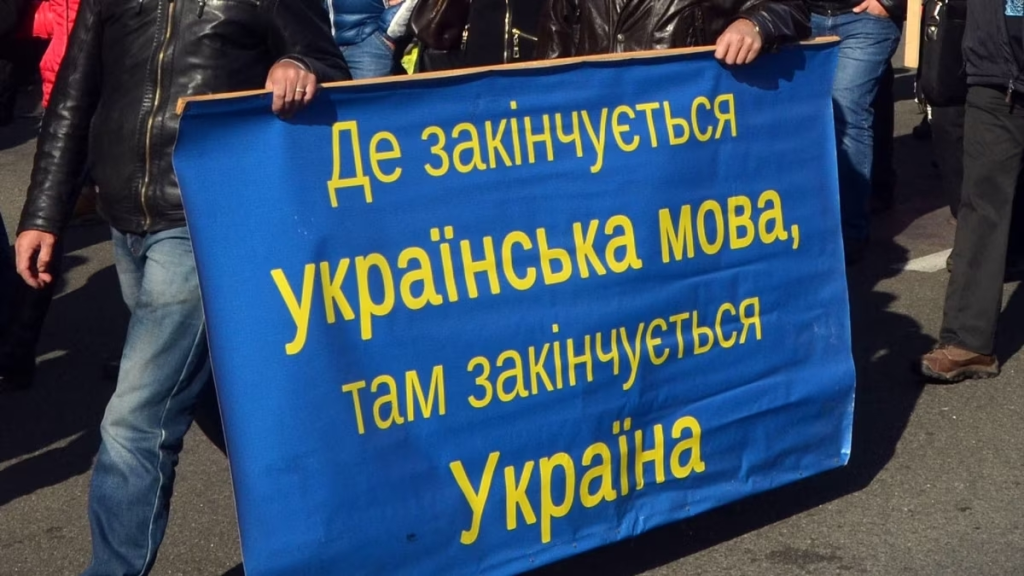
фото з відкритих джерел
Source: Author’s Facebook page
The issue is not about linguistics — it’s about sovereignty. The Verkhovna Rada’s hesitation to adopt Bill No. 14120 on the Language Charter plays straight into Moscow’s hands. Every delay strengthens the Kremlin’s favorite narrative: that Ukraine can’t or won’t defend its own cultural foundation. Attempts to block this law are not “debates about minority rights” — they are deliberate, pro-Russian operations aimed at eroding Ukraine’s statehood from within.
The European Charter for Regional or Minority Languages is a Council of Europe document designed to protect linguistic diversity across the continent. Contrary to Russian propaganda, the Charter does not protect the rights of national minorities as such — it protects languages that are endangered or require special support.
The Charter is not a benchmark of a country’s “Europeanness” or democratic maturity. Many EU member states — including Estonia, Lithuania, Latvia, Greece, Bulgaria, and Belgium — have never signed it, which has in no way affected their EU membership. Others, such as France and Italy, have signed but not ratified it. Needless to say, Russia has not signed the Charter either, though it routinely exploits the document to pressure Ukraine and other states.
Ukraine, even under Kuchma and Tabachnyk, not only signed the Charter but also managed to ratify it twice. The first ratification law, adopted in 1999, was declared unconstitutional by the Constitutional Court in 2000. As a result, the Charter was ratified again in 2003.
None of this would have mattered if Ukraine’s pro-Russian authorities had not deliberately distorted the translation of the Charter. Its name — European Charter for Regional or Minority Languages — and the key term were rendered as “regional languages or MINORITY LANGUAGES.” This manipulation was intentional, allowing the 2003 ratification law to claim it protected “languages of such national minorities” and to insert the Russian language into the list.
As a result, Russian was enshrined in Ukrainian law alongside languages that genuinely require state support. Yet, Russian was never under threat in Ukraine; on the contrary, it has long posed a threat to both the Ukrainian state language and Ukraine’s true minority languages.
This shameful law, which distorts the Charter’s text and contradicts Ukraine’s national interests and common sense, remains in force. The need for a correct official translation and amendments to the ratification law has been repeatedly emphasized by Ukrainian lawyers, linguists, and public authorities.
On July 14, 2021, the Constitutional Court of Ukraine, in Decision No. 1-r/2021, stated:
“The Ministry of Foreign Affairs of Ukraine, the Cabinet of Ministers of Ukraine, and the Verkhovna Rada of Ukraine, in accordance with their powers and competence, must establish clarity regarding the official translation of the Charter into Ukrainian, and take all necessary actions to ensure Ukraine properly fulfills its obligations under the Charter as an international treaty, since the existing legal disorder undermines the effectiveness of Articles 8, 9, 10, and 11 of the Constitution of Ukraine.”
In 2024, the Shmyhal government introduced a bill that fully complied with the Constitutional Court’s order. The humanitarian committee of the Verkhovna Rada approved it. However, just one day before the plenary session in January 2025, the bill was removed from the agenda, allegedly due to pressure from unnamed “Europeans.”
History repeated itself: the bill was postponed “for a few weeks” to avoid upsetting these mysterious “European partners.” Yet the Servants of the People faction never returned the bill to the agenda before Shmyhal’s resignation, which, under parliamentary rules, caused the automatic withdrawal of the legislation.
Bill 14120, introduced by the Svyrydenko government, largely replicates the previous draft and, importantly, does not include the Russian language. Credit is due to the Ministry of Culture, the Ministry of Foreign Affairs, and the Cabinet as a whole for demonstrating consistency on this issue. The Humanitarian Committee recommended adopting the bill in full, with important clarifications to protect the Yiddish, Rumey, and Urum languages.
The bill was initially placed on the plenary agenda for the first week of November. However, as is now clear, at the request of Deputy Prime Minister Kachka and the Head of the State Service for Ethnopolitics, Yelensky, the Servants of the People faction intends to shelve it — once again, just as in January, under the pretext of semi-mythical “European experts.”
It is obvious that any Ukrainian or foreign figures who advocate preserving a falsified translation of the Charter and obstruct the implementation of the Constitutional Court’s order are acting against both the national interests of Ukraine and common sense. No European integration rhetoric — the kind once favored by Tabachnyk, Kivalov, and Kolesnichenko — can conceal the fact that such actions benefit only the aggressor state, Russia, which uses the Russian language as a tool of war and occupation.
No one — neither Russian lobbyists in European institutions nor individual government officials obstructing the adoption of their own government’s draft law — should dictate which bills the parliament considers. The Commissioner for the Protection of the State Language, Olena Ivanovska, along with numerous MPs and public figures who have recently urged the parliament not to postpone consideration of Bill 14120, are absolutely correct.
We must categorically reject the demagogy claiming that removing the Russian language from the list of languages protected by the Charter somehow violates minority rights. The Russian language will still receive legal protection on par with other minority languages, of which Ukraine has dozens. However, it will not be among the 15 languages for which Ukraine is obligated under the Charter to provide enhanced protection and support, in line with the Charter’s original purpose.
The horror stories suggesting that the adoption of Bill 14120 would hinder Ukraine’s European integration are blatant bluffing. Any European figure opposing the correction of the Charter’s distorted translation, and its proper use — including the protection of Yiddish, Urum, and Rumey languages — exposes themselves as Russian agents, xenophobes, or anti-Semites. Only long-standing Russian operatives would take such a position. It is therefore crucial that Ukrainian officials and MPs refuse to act as passive executors of Moscow’s whims.
Also, follow “Pryamyi” on Facebook, Twitter, Telegram, and Instagram.
• Materials published in the “OPINIONS” section reflect the opinion of the author of the publication, who bears full responsibility for the accuracy of the information.
• The editorial staff of prm.ua may not share the opinions expressed in the author’s material.
• The owner of the webpage in the “OPINIONS” section is the author of the publication.