


Kremlin Zugzwang: Putin is losing control of the Russian political system


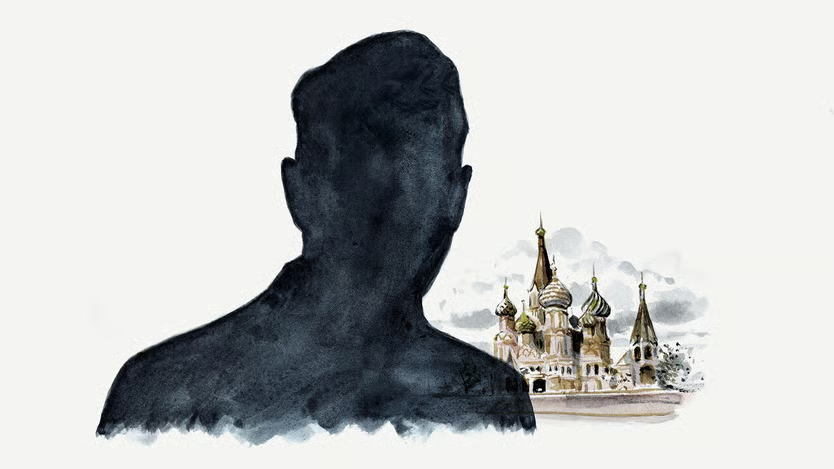
ілюстрація The Economist
Western analysts are recording increasing signs of a power crisis in Russia, accompanied by a loss of unity around military actions and growing economic pressure.
According to The Economist, the current situation shows that Kremlin dictator Vladimir Putin has finally led the country into a strategic and political deadlock. The main indicator of this process has been not only the decline of the economy, but also a significant transformation of the language used by representatives of power circles.
“The formula “we”, which symbolized the unity of elites around the Kremlin’s decisions, is disappearing,” the authors of the study note.
Russian officials and business representatives previously described the war as a joint project, but now they are trying to distance themselves from this process. The inner circles increasingly perceive the actions of the Kremlin leader as detached from the general path of the country. The leader’s behavior raises doubts within the system, as his steps seem illogical for future development.
Decisions by the top are now more often described as “strange.” This perception indicates that the political center has become autonomous and no longer reflects the interests of those who previously formed the basis of the regime’s support.
At the same time, The Economist outlined several key dimensions of the crisis in Russia:
• The cost of war: the consequences of the conflict are becoming increasingly felt by the population – inflation, rising taxes, and strain on infrastructure, while the strategic purpose of the war remains unclear.
• Lack of rules: There is a large-scale redistribution of property, accompanied by asset confiscations. Business elites seek stability, but face the advantage of the “right of might.”
• Geopolitical weakening: Russia has lost some of its international influence, particularly in the energy sector, and its position in global institutions has weakened.
• Identity crisis: lack of a clear internal development model after the loss of traditional opposition to the West.
Analysts also note that the old social contract – “comfort in exchange for political passivity” – no longer works. Instead, loyalty is demanded from citizens and elites without guarantees of stability or development. However, the Kremlin’s ideological model does not offer a clear scenario for ending the conflict or “victory”, which creates a state of long-term instability, the material says.
As a result, the situation is being compared to a zugzwang: any further steps by the Russian leadership – from increased repression to new military actions – only deepen the systemic crisis.
As reported by “Pryamiy”, the internal situation in Russia is showing signs of destabilization due to economic hardship and a protracted conflict. According to official Russian polls, the level of distrust in the dictator has reached 24% , which is the highest figure since February 2022.
It was previously reported that Ukrainian special services obtained recordings of telephone conversations of the head of the Central Bank of Russia, Elvira Nabiullina, who in a private conversation gave extremely pessimistic forecasts about the stability of the Russian financial system in the coming months. These data differ significantly from the official Kremlin propaganda.
By the way, the leader of the Russian communists, Gennady Zyuganov, has stated that there is a risk of a repeat of the 1917 revolution in Russia amid economic problems and growing discontent. According to him, the Russian economy is rapidly deteriorating, and he called the first quarter of the year a “complete disaster.” Zyuganov called on the authorities to urgently make financial and economic decisions, otherwise the country could face a scenario similar to the events of 1917 in the fall.