


Lifting a Moratorium That Never Existed: Moscow’s Missile Theatre Continues


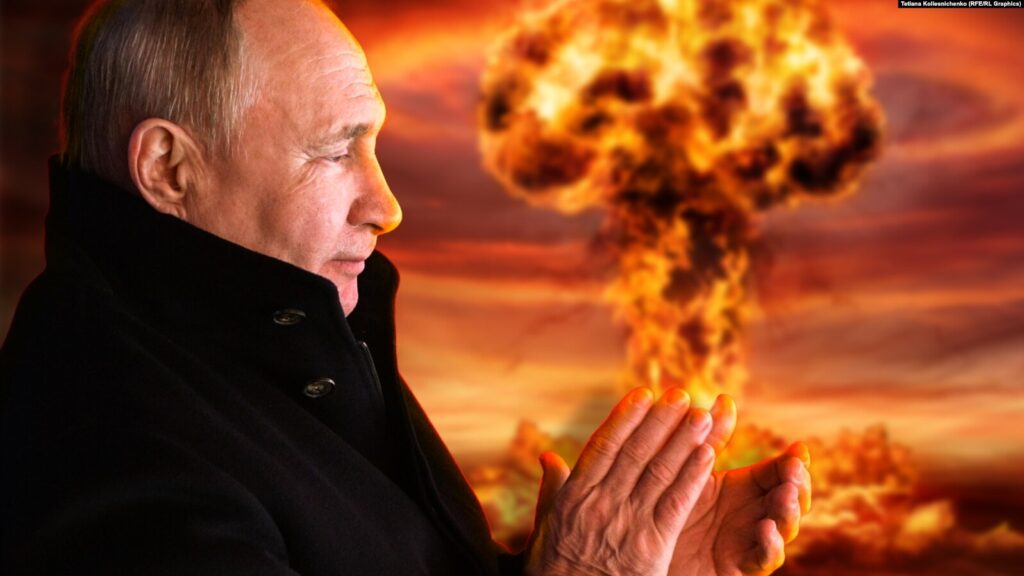
фотоколаж: "Радіо Свобода"
The occupying country has officially announced its withdrawal from the moratorium on the deployment of ground-based intermediate- and shorter-range missiles — a decision that surprised absolutely no one, except perhaps its diplomats.
Recently, the Russian Foreign Ministry declared that it no longer considers itself “bound by a moratorium” on the deployment of such weapons. The statement, cloaked in the usual fog of strategic victimhood, claimed:
“The United States and its allies have not only publicly outlined plans to deploy American land-based INF (intermediate- and short-range missiles) in various regions, but have already made significant progress in practically implementing these intentions.”
The Ministry added that any deployment decisions will be made “based on an interdepartmental analysis of the scale of U.S. and other Western missile deployments, as well as the overall development of the international security situation and strategic stability.” In other words, we’ll do it when we feel like it.
Notably, Russia had for some time avoided giving clear responses to U.S. actions, apparently hoping the situation would quietly resolve itself. This hesitation betrayed a degree of confusion, as if Moscow didn’t quite anticipate the shift in Washington’s tone. For decades, the Kremlin wielded the nuclear card as a tool of psychological pressure, while successive U.S. administrations, particularly under Obama and later Biden, responded with studied restraint, treating the bluster as little more than background noise.
But then came Donald Trump.
Never one for subtlety, Trump dismissed diplomatic dance routines entirely. “Medvedev talked about nuclear weapons — when you talk about nuclear weapons, we have to be ready. We are fully prepared,” he proclaimed, as if casually announcing the weather forecast. The bluntness reportedly left the Kremlin momentarily stunned, unused as it was to being out-blustered.
Following Trump’s comments, Washington’s rhetorical shift began to materialize in military terms. According to the UK Defense Journal, the United States may have transferred several B61-12 thermonuclear gravity bombs to RAF Lakenheath in Suffolk, UK — a quiet little village now potentially sitting atop several megatons of diplomacy.
https://ukdefencejournal.org.uk/us-nukes-deployed-to-england-for-first-time-in-over-a-decade/
Hans M. Kristensen, director of the Nuclear Information Project at the Federation of American Scientists, stated there were “strong indications” that the United States had returned its nuclear weapons to the United Kingdom. “There is strong evidence that the US has returned nuclear weapons to the UK… Returning US nuclear weapons to the UK is no easy feat,” he emphasized — as if to remind us that moving megatons of destruction across oceans requires more than just a memo.
In parallel, former US President Donald Trump once again stole the show with his signature flair for the dramatic. He revealed that American nuclear submarines were stationed near Russian waters — a follow-up to his earlier warning, issued in response to Dmitry Medvedev’s latest round of apocalyptic blustering.
The irony here is hard to miss. Washington used Medvedev’s nuclear grandstanding as a justification to expand its nuclear footprint near Russia’s borders. Classic political aikido: Use your opponent’s momentum to throw him off balance. And Moscow, to its evident dismay, realized this a little too late.
The Kremlin’s initial reaction came in the form of a cautious, almost sheepish, statement from presidential spokesman Dmitry Peskov, who assured the public that the Russian leadership is “very careful” with nuclear rhetoric. He quickly added that Russia’s official foreign policy line is defined not by Medvedev — the eternal understudy — but by President Putin himself.
After that, Medvedev fell silent. No more doomsday tweets. No more Armageddon-themed press briefings. Just a demonstrative — and humiliating — pause. The Americans had successfully baited and silenced one of Moscow’s loudest voices.
More intriguing is what Putin didn’t say. No comment on the reported redeployment of U.S. nuclear bombs to the UK. No comment on American submarines lurking off the Russian coast. Just a statement from the Foreign Ministry declaring the end of Russia’s self-imposed moratorium on medium- and short-range missiles. On the surface, this appeared to be a forceful response. But that’s only at first glance.
Let us rewind the tape: in June 2024 — over a year ago — Putin already announced the lifting of the moratorium on precisely these kinds of weapons. On June 28, during a Security Council meeting, he discussed abandoning restrictions on the deployment of land-based intermediate- and shorter-range missiles. So, the recent announcement isn’t a bold new policy shift. It’s a rehash. A recycled headline.
Which leads us to the obvious question: What is the purpose of this déjà vu statement?
In my view, it’s an attempt to keep a straight face amid a strategic fiasco. The United States has delivered a calculated blow across military, economic, and political fronts. And Russia — caught off guard — is scrambling to project strength with gestures that are, at best, performative.
Let’s not forget that in 2019, Putin had solemnly declared:
“We will not produce these missiles and will not deploy them until the United States deploys such systems in any region of the world.”
That red line has faded with time — or perhaps, as is often the case in Kremlin affairs, it was drawn in pencil to begin with.
That is, legally, since 2019, both parties have not been bound by this agreement.
So, the Russian Foreign Ministry’s latest high-volume statement is less a geopolitical move and more an exercise in theatrical posturing. It’s an attempt to project information “power” without backing it with real action — a kind of diplomatic cosplay.
This mirrors events from 2023, when Russia loudly declared it was “suspending” its participation in the Strategic Arms Reduction Treaty (START), but crucially, not withdrawing. Back then, too, the Foreign Ministry issued a statement… in which Moscow pledged to continue observing existing limitations and hinted that participation could resume “at the president’s discretion.”
Let’s pause here. In international law, there is no such thing as “suspension” in the way Russia uses it. This is pure newspeak — a diplomatic invention that means absolutely nothing in practice. Smoke, mirrors, and bureaucracy.
What’s really behind this new round of missile-threatening rhetoric?
Quite possibly, the U.S. is dusting off the old Reagan-era playbook. The strategy? Exhaust Russia economically by luring it into another arms race — the same tactic that helped dismantle the Soviet Union.
Let’s recall: in the 1980s, alongside ballooning American defense budgets, the U.S. quietly pressured Persian Gulf countries to ramp up oil production. Prices dropped. Soviet export revenues collapsed. The empire wobbled, then fell.
Fast-forward to now. The Gulf states, again under American influence, have increased oil production by 540,000 barrels per day. The price per barrel has already dropped by $2 — a shift that may seem small, but in Russia’s metro-economy, even minor fluctuations cut deep.
And Moscow’s response? Predictably imperial: more tanks, more missiles, more parades.
According to Ukraine’s Main Intelligence Directorate, as cited by General Kyrylo Budanov, Russia plans to spend $1.1 trillion by 2030 on military rearmament in preparation for a hypothetical confrontation with NATO.
“I know this document very well,” Budanov said in an interview with Moseychuk+. “The program totals 90 trillion Russian rubles. Its number one task is to prepare Russia for this confrontation. The spending peak will be before 2030. After that, the curve goes downward.”
In other words: welcome to the new five-year plan — military edition.
But here’s the problem for the Kremlin: the Soviet Union at least had an industrial economy to back its ambitions. Russia today has a commodity-dependent economy, plagued by sanctions and capital flight. Already, over 6.6% of its GDP is swallowed by defense spending. The budget deficit stands at 2.2% of GDP, or roughly $50–60 billion. And it’s rising.
In essence, Russia is stumbling into a Cold War 2.0 without the economic oxygen to survive it.
Meanwhile, the United States is only warming up. The strategy is classic: provoke your adversary into overspending on defense while you control the pace of escalation. Slow, methodical attrition — Cold War judo.
So, what does all this tell us?
That Russia’s latest statement isn’t a strategic breakthrough — it’s a strategic miscalculation. It’s a reaction, not an initiative. It reveals not strength, but confusion. And most importantly, it makes clear who currently holds the upper hand in this long game of pressure and patience.
Spoiler: it’s not the side recycling decade-old press releases and redefining treaties on the fly.
Also, follow “Pryamyi” on Facebook, Twitter, Telegram, and Instagram.
• Materials published in the “THOUGHTS” section reflect the opinion of the author of the publication, who bears full responsibility for the accuracy of the information.
• The editors of prm.ua may not share the opinions expressed in the author’s material.
• The owner of the web page in the “THOUGHTS” section is the author of the publication.