


“Shaheeds” over Kyiv can be controlled from the city itself – Fedienko


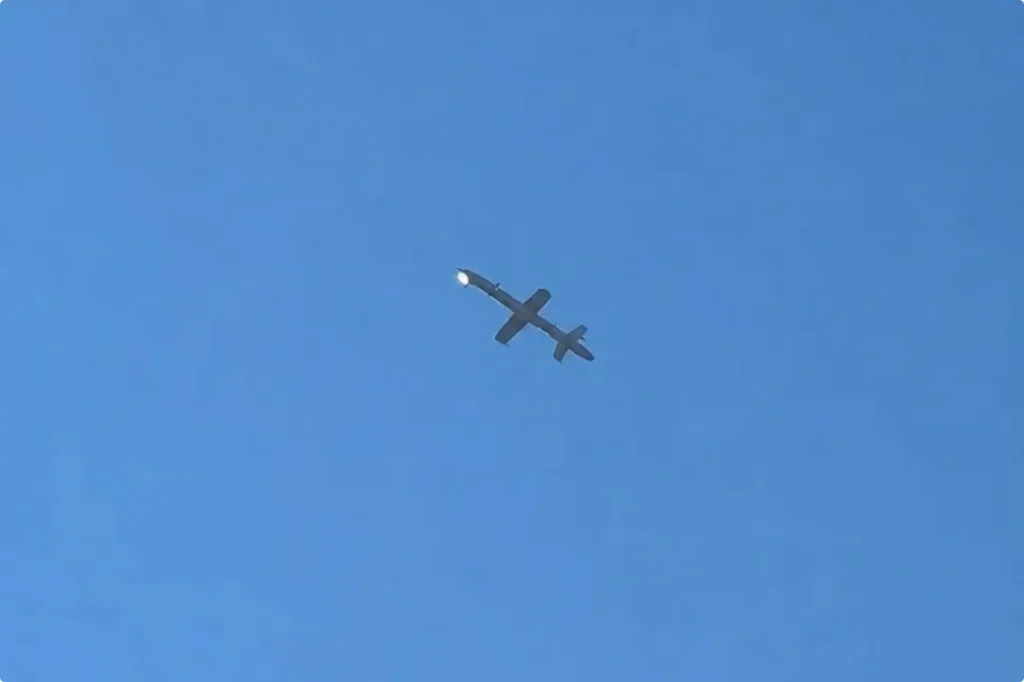
The Russians are unlikely to be able to directly control the Shahed drones over Kyiv from Russian territory due to radio communication restrictions. To do this, they could use transmitters closer to the capital or build a mesh network in which some drones act as repeaters for others. Such versions were put forward by MP Oleksandr Fedienko after his own technical calculations.
According to him, recently there has been information that the Russians are allegedly remotely controlling the “Shaheds” from their territory. In particular, strikes on the SBU building, the INCOM business center, and other objects in Kyiv are associated with this method of guidance.
Fedienko, who worked with wireless systems before entering politics, decided to check how technically feasible such a scheme was.

For calculations, he took a building in the Shulyavka area, the conditional launch point of “Shaheda”, the flight altitude of the drone and a possible repeater. He also took into account the types of antennas, their polarization, the characteristics of the XK-F358 modem, the terrain, and the condition that the modems must support a data transmission channel at 10 Mbps.
According to Fedienko’s calculations, if one of the transmitters is at an altitude of 3 km and the other at 30 meters, the radio horizon will be about 248 km. At the same time, the point from which the Russians could transmit a signal from their territory is located much further away.
At a frequency of 3.3 GHz in the middle of such a route, the first Fresnel zone, according to his calculations, will have a radius of about 81 meters, and for stable operation of the channel, about 49 meters of free zone are required.
Fedienko notes that even in his calculations he raised the Shahed to a height of 3 km. If the drone flies lower or begins to descend before the attack, maintaining a direct communication channel at such a distance becomes even more difficult.
That is why he calls one of the possible schemes the use of stationary transmitters already near the target, in particular in Kyiv. According to his version, such a device simply needs to be connected to the Internet, after which data can be transmitted to the drone through it.
At the same time, Fedienko is considering another option – a mesh network. In such a scheme, one “Shahed” can actually work as a repeater for another, transmitting the signal further. The next drone continues this chain, and thus communication can be maintained at a much greater distance.
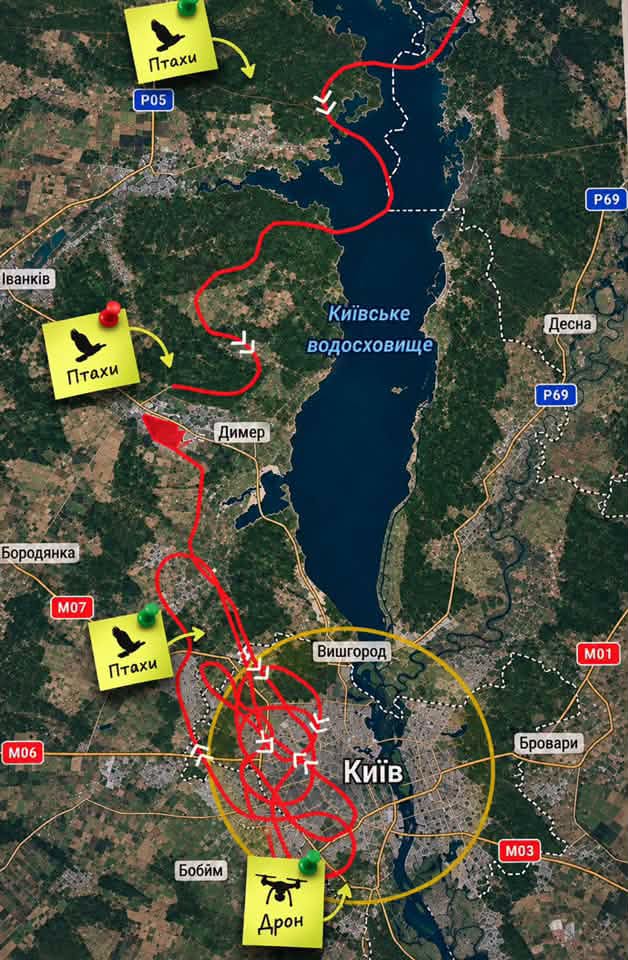
According to the MP’s observations, during one of the attacks, the drones’ behavior could resemble exactly this pattern: one drone would remain in the air and could act as a repeater until another appeared between it and the next point. After that, another drone could join the network.
However, in this case, Fedienko suggests, additional repeaters closer to Ukraine, in particular on the territory of Belarus, might be needed to build the entire chain.
At the same time, Fedienko does not claim that any of these schemes are actually used by the Russians. These are technical versions of them, which, according to the MP, should be checked by the relevant services.