


Extradition Blocked: How NSDC Sanctions Are Protecting Corrupt Officials


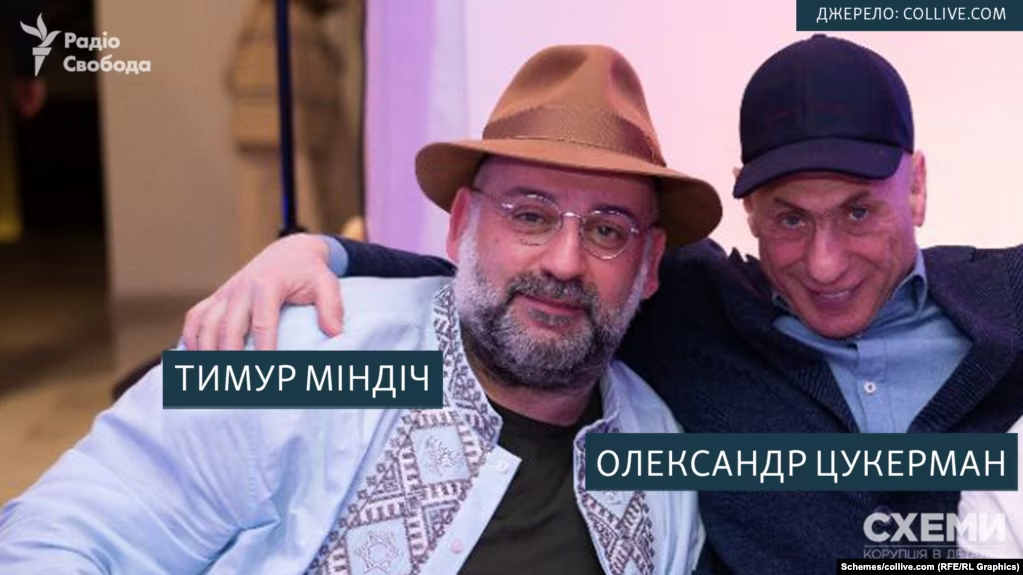
фото: "Схеми"
Source: Author’s Facebook page
The NSDC’s decision to sanction Mindich and Zuckerman may have effectively blocked or made their extradition to Ukraine nearly impossible. Was this a deliberate move — or just another case of miscalculated consequences? In the end, it may no longer matter.
But the sanctions imposed by the National Security and Defense Council on Ukrainian citizens are not legally justified and can complicate extradition cases. I will explain how later.
Sanctions are always a political instrument. They are adopted by politicians to achieve legally defined foreign policy objectives and are typically applied against foreigners or foreign states as a tool of diplomatic pressure, meant to compel compliance with certain political conditions.
When a state imposes sanctions on its own citizens, however, the situation takes on a very different meaning. Legally, it amounts to the highest political authority targeting a citizen through political decisions. In other words, it is easy to characterize this as “political persecution.” After all, why do some corrupt officials face court sentences, while others are subjected to a political decision by the National Security and Defense Council, implemented through a decree of the President of Ukraine?
The NSDC’s decision regarding Mindich states that sanctions were imposed on him as an Israeli citizen. Legally, however, this is incorrect.
Numerous public documents list Timur Mindich as a Ukrainian citizen. This is recorded in the State Register of Legal Entities and reflected in the ownership structure of the Viasat satellite platform, where he is one of the co-owners.
In other words, in addition to any other passports, Mindich holds a Ukrainian passport. Under Ukrainian law, in legal relations with Ukraine, he is recognized only as a citizen of Ukraine. The Law on Citizenship explicitly states: “If a foreigner has acquired Ukrainian citizenship, then in legal relations with Ukraine he is recognized only as a citizen of Ukraine.”
This also explains the State Border Guard Service’s statement that Mindich left the country not as a foreigner — for whom travel restrictions do not apply — but as the father of three minor children. This provision applies solely to Ukrainian citizens.
For these reasons, Mindich is not listed as an Israeli citizen in Ukrainian registers. Consequently, the imposed sanctions cannot be enforced, since all his assets are registered under his status as a Ukrainian citizen, not Israeli. This detail highlights how little thought went into the legal feasibility of these sanctions.
Thus, the sanctions against Mindich legally amount to political persecution of a Ukrainian citizen. Paradoxically, he has no known political involvement or stated beliefs, yet this is precisely the argument his lawyers can now use.
Importantly, extradition conventions and Interpol rules prohibit the extradition of individuals subject to political persecution. As a result, despite the euphoria the sanctions may generate on social media, they are highly likely to complicate — or even make impossible — the completion of a criminal investigation.
It is difficult to say why the NSDC is again imposing sanctions on Ukrainian citizens. In most cases, this is more of an element of political PR: instead of a systematic investigation, the public is shown a press release about sanctions, which creates the illusion of action. This temporarily removes the public demand for justice. But at the same time, such decisions undermine trust in the legal system and create precedents that can be used against the state itself.
And this is exactly what we will most likely observe in the case of Mindich – literally on live television.
On the eve of the President of Ukraine, Volodymyr Zelenskyy, imposed NSDC sanctions against the co-owner of “Kvartal-95” Timur Mindich, and businessman Oleksandr Zuckerman, who are linked to the corruption case in the energy sector. However, the relevant decree shows that despite the previously promised large-scale sanctions, Zelenskyy limited himself to a three-year term, although at least ten years were previously discussed. The document emphasizes that Mindich and Zuckerman are citizens of Israel – a detail that has long raised questions about the real criteria of the current government’s sanctions policy.
Also, follow “Pryamyi” on Facebook, Twitter, Telegram, and Instagram.
• Materials published in the “OPINIONS” section reflect the opinion of the author of the publication, who bears full responsibility for the accuracy of the information.
• The editorial staff of prm.ua may not share the opinions expressed in the author’s material.
• The owner of the webpage in the “OPINIONS” section is the author of the publication.