


“Privat” Mafia Strikes Back: Meet the New Power Broker Behind Ukraine’s Most Notorious Clan


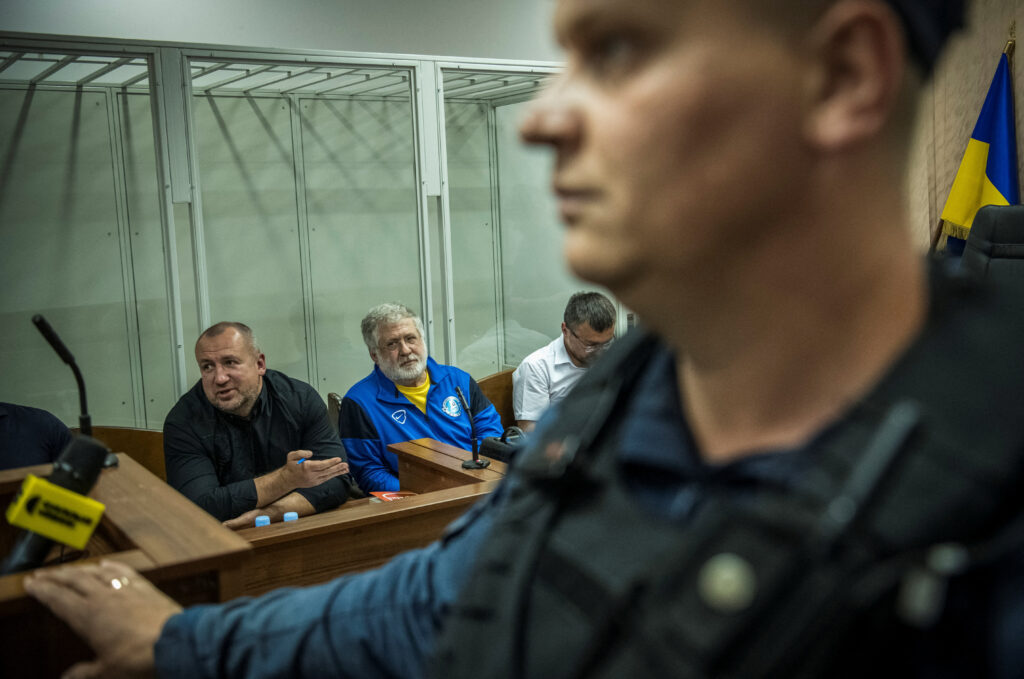
фото: Reuters
Source: Author’s Facebook page
When Kolomoy was taken into custody, it became clear that the Dnipro mafia clan wasn’t gone — only regrouping. The old boss had fallen, but a new, younger, and bolder one was ready to take his place.
The only real question was: who would take over as the new mafia boss?
Today’s revelations — that the president’s long-time friend and co-founder of Kvartal 95 allegedly oversaw a criminal scheme worth billions — make the answer painfully clear:
Volodymyr Zelenskyy has become the new mafia boss.
Now, Zelenskyy stands at the apex of a corruption empire worth billions. He is no longer just another corrupt official or a typical Eastern European bureaucrat with sticky fingers in state contracts.
Under him operates a tightly-knit criminal network — seasoned fixers, grifters, foremen, and foot soldiers — all playing their parts. They wear the masks of businessmen, volunteers, former activists, journalists, MPs, and civil servants. In reality, they’re gang members with assigned roles — men and women who carry cash-stuffed bags and vanish into the woods the moment the skies start to darken.
Some mafias traffic in drugs, prostitution, or kidnapping. The Dnipropetrovsk clan, however, deals in something far more lucrative — large-scale financial crime.
For years, Ukraine’s mafia bosses have preferred to call themselves oligarchs. It sounds respectable, even patriotic. But let’s be honest: that’s a euphemism they invented for themselves. If you have money and earned it legally, you’re an entrepreneur — no matter how much the envious lumpen might despise you. But if your fortune comes from stealing state assets or threatening officials, you’re not an oligarch — you’re a bandit. And if you’ve built a criminal network to keep repeating those crimes, you’re the head of a criminal organization. Simple as that.
Judge Sarah Trauer of the London High Court made this distinction clear in her August ruling in the PrivatBank case.
According to the judgment, during one tense meeting over PrivatBank’s looming collapse, Ihor Kolomoisky threatened the head of Ukraine’s National Bank, Valeria Hontareva, warning that if the bank were nationalized, he would flee to Israel — and still “get” the NBU leadership from there.
At one point, the judge wrote, Hontareva walked out. Kolomoisky then turned to deputy, Kateryna Rozhkova, patted his stomach and said: “The tiger in the cage is hungry, but the door is open — you can leave.” Then he added, chillingly: “My arms are long. I’ll find you anywhere.”
After that encounter, Rozhkova refused to meet him again.
And, as it turned out, Kolomoisky meant every word. Not long after, unknown men burned down Hontareva’s house.
The Dnipropetrovsk mafia isn’t just a criminal group — it’s a state within a state, built with precision and cynicism over decades. Its structure mirrors that of a multinational corporation, only its core business is corruption.
Here’s how the empire works:
• Many factories were stolen or seized — most of them had once been state-owned.
• A bank turned pyramid. PrivatBank, once the largest in Ukraine, became a vast laundering machine — siphoning off billions from depositors before nationalization, then draining those very funds through a web of shell firms controlled by the same mafia circle.
• A political front. Dozens of bribed MPs, ministers, and officials serve as camouflage. One PrivatBank manager who designed part of the fraudulent scheme, according to London court materials, is now listed as an aide to an MP from Servant of the People — elected in Dnipropetrovsk, naturally.
• Media control. Their media empire is massive — entire TV networks designed not to inform, but to manipulate.
• Paid propagandists. “Journalists,” “activists,” and professional opinion-shapers swarm social media and television. When Kolomoisky was finally detained, some of these familiar faces were spotted in court, offering bail money.
• Tame clergy. Even local religious figures weren’t off limits. The Dnipropetrovsk rabbi’s involvement in the KZRK deal remains one of the more absurd, if telling, episodes.
• Court jesters turned cover artists. Comedy troupe Kvartal 95 — co-owned by Timur Mindich — mocked the arson attack on Valeria Hontareva’s home in their sketch “The House Burned, It Burned.” The message was clear: laugh it off, forget the crime.
• Propaganda factory. Like every serious mafia, they have their own studios, turning TV shows and films into subtle tools of influence. From Tokyo to Naples, the formula is the same: when the state turns against you, control the narrative.
At the top of this structure sit two men who managed the “information front” of the Dnipropetrovsk clan — Volodymyr Zelenskyy and his long-time friend, Timur Mindich. Together, they built not just Kvartal 95, but a propaganda machine powerful enough to rewrite reality itself.
The mafia disguised itself as both a financial empire and a public, national-ethnic organization.
According to an SBU investigation, the upper ranks of the syndicate — Kolomoisky, Boholiubov, and Rabinovych — along with lower-level members, used the accounts of the Jewish Community of Ukraine to launder billions in stolen funds. A ruling by the Shevchenkivskyi District Court states that members of the group embezzled and legalized ₴5.8 billion through the organization’s accounts.
Such actions are utterly reprehensible. By doing so, these criminals not only stole public money but also fuelled antisemitic sentiment through their cynical exploitation of Jewish institutions.
Masquerading as a “Jewish community”, they funded projects of a religious or cultural nature — including, for instance, the Hurva Synagogue in Jerusalem. Using money looted from Ukrainians, the mafia bought themselves a reputation as respectable gentlemen and benevolent Jewish philanthropists abroad.
Timur Mindich himself chairs the council of the All-Ukrainian Association of Jewish Public Organizations, United Jewish Community of Ukraine, and sits on its board. The former clan boss serves as the organization’s president.
At the same time, Mindich, together with Zelenskyy, co-founded the offshore company Green Family Ltd., which, according to journalists, received part of the stolen PrivatBank deposits — $6 million out of a total $41 million.
This is the classic double life of a criminal organization: by day, respectable citizens — the mafia sleeps; by night, the mafia wakes.
Is it any wonder Europe keeps its distance from us?
It was Johan Parts, the author of the EU’s 2021 corruption report on Ukraine, who described the situation most precisely: “state capture.” Parts wrote bluntly that in Ukraine, a small group of people has seized control of the state and is using all its resources for criminal purposes. The problem, he said, is systemic — and this remains the collective view of the European Union.
“In Ukraine, we are dealing with a case of so-called state capture. It is endemic. Nothing new. A widely recognised fact.”
For those who need it spelled out:
State capture means a group of people exploit their positions — using the media, politics, governance, and state-owned enterprises — for their own personal gain.
But much has changed since 2021. We are now witnessing a textbook evolution of a criminal organization: the young gang members pushed the old boss aside and assumed control themselves.
There is a new boss in the Privat clan.
Last summer, spooked by law enforcement wiretaps in the Ministry of Justice, he panicked and gave himself away, attempting to destroy NABU in the Verkhovna Rada.
The new boss is Volodymyr Zelenskyy himself.
The history of this clan is long and tangled; one could easily write a hundred more pieces about it. But what does this grim story mean in wartime? It shows that jailing a mafia boss does not destroy the clan.
The foot soldiers simply reorganize and crown a new Don Corleone. Yesterday, he was a young, pleasant‑faced man; today, he has grown a beard, turned macho, and majestically lets people kiss his hand.
Ukraine’s primary task is to survive under the shadow of this criminal organization — and then to dismantle it. Without that, the wolves will keep changing places around the Yule log, and they will steal our future.
Also, follow “Pryamyi” on Facebook, Twitter, Telegram, and Instagram.
• Materials published in the “OPINIONS” section reflect the opinion of the author of the publication, who bears full responsibility for the accuracy of the information.
• The editorial staff of prm.ua may not share the opinions expressed in the author’s material.
• The owner of the webpage in the “OPINIONS” section is the author of the publication.