


Ministry of Digital Transformation Accused of Social Media Censorship in Ukraine


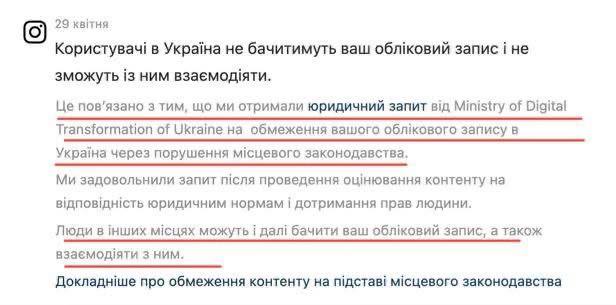
A seemingly minor incident has raised major concerns about digital freedoms in Ukraine: Instagram has blocked the account of the Zhytomyr branch of European Solidarity — reportedly at the request of Ukraine’s own Ministry of Digital Transformation.
This implies the following:
1. It is now a documented fact that censorship on social media in Ukraine is carried out by the Ministry of Digital Transformation and its head, who appears to have reached an agreement with the leadership of major social platforms.
Is the main role of Ukraine’s Ministry of Digital Transformation now to protect the political regime? Possibly. Could projects like Diia and the digitalization of corruption-fighting mechanisms have become secondary — a bonus, so to speak? Perhaps.
2. It has also been confirmed that the American tech giant Meta does, in fact, block accounts at the request of the current Ukrainian authorities. Not all such requests are likely granted: Meta presumably reviews each case for compliance with Ukrainian law — potentially through an external law firm, as is common practice for American corporations. However, the criteria by which these requests from the Ministry are assessed, the percentage that are approved, and the process behind them all remain unknown.
3. If some accounts are being blocked at the request of the Ministry, it is logical to assume that account blocking is not the only form of punishment being applied. Specific posts — or even an entire account — could be subject to “restriction,” meaning they are shown to only a limited portion of the account’s audience. This could be 10%, 20%, 50%, or even 80–90%.
This practice is commonly referred to as a “shadow-ban.” The key feature is that the user is never informed of any imposed restrictions. They simply notice a sudden and unexplained drop in engagement and reach.
That is exactly what has happened to me multiple times over the past year. I am currently experiencing a shadow-ban myself. Most likely, it was initiated by the Ministry of Digital Transformation as a form of bureaucratic reprisal. Instead of directly blocking my account, Facebook seemingly responded to the Ministry’s request by quietly limiting its visibility.
4. Can this be considered an example of military censorship?
No. There’s no evidence of any military involvement in this case.
Can it be considered political censorship?
Yes, quite possibly.
Government agencies, using opaque and undefined criteria, contact an international social media platform with a request to block the page of a political opponent.
Neither the Ministry of Digital Transformation nor the platform’s administration has disclosed which specific content led to the account being entirely blocked. This lack of transparency strongly suggests political bias behind the censorship.
5. At the same time, no similar restrictions are applied to posts made by a member of the ruling political party — despite those messages aiming to destabilize and divide society during wartime. These statements provoke both civilians and military personnel into making rash decisions or inflammatory comments. Yet, the Ministry of Digital Transformation seems to “overlook” the destructive rhetoric coming from one of its own — despite each such message generating significant public outcry.
Several other points indicate that this is a case of political, not military, censorship: the social media blocking efforts are being coordinated by individuals who have never served a single day in the armed forces or any paramilitary structures. Moreover, their chief official has allegedly evaded military service on four separate occasions and has even publicly ridiculed it.
The official justification for such takedown requests is often phrased as a measure to “safeguard Ukraine’s information security.”
However, in 2019, the current Minister for Digital Transformation, Mykhailo Fedorov, publicly stated in an interview: “The role of cybersecurity is somewhat exaggerated.”
Conclusion: Politically motivated censorship on social media is no longer speculative — it is a documented and observable reality in today’s Ukraine.
How long has this been happening? Why now? Why has Mark Zuckerberg’s company begun to tolerate politically motivated censorship in Ukraine? Does this practice serve the cause of democracy — in Ukraine or globally? Will censorship help us win the war? Or is Ukraine slowly morphing into a weaker version of Russia? How long until people begin to be imprisoned for “offensive language” or for “discrediting the government”?
I will wait for answers to these questions in the comments or here.

Also, follow “Pryamyi” on Facebook, Twitter, Telegram, and Instagram.
• Materials published in the “THOUGHTS” section reflect the opinion of the author of the publication, who bears full responsibility for the accuracy of the information.
• The editors of prm.ua may not share the opinions expressed in the author’s material.