


From Afar, Impact Up Close: How Oil Strikes Are Hammering Russia’s Economy


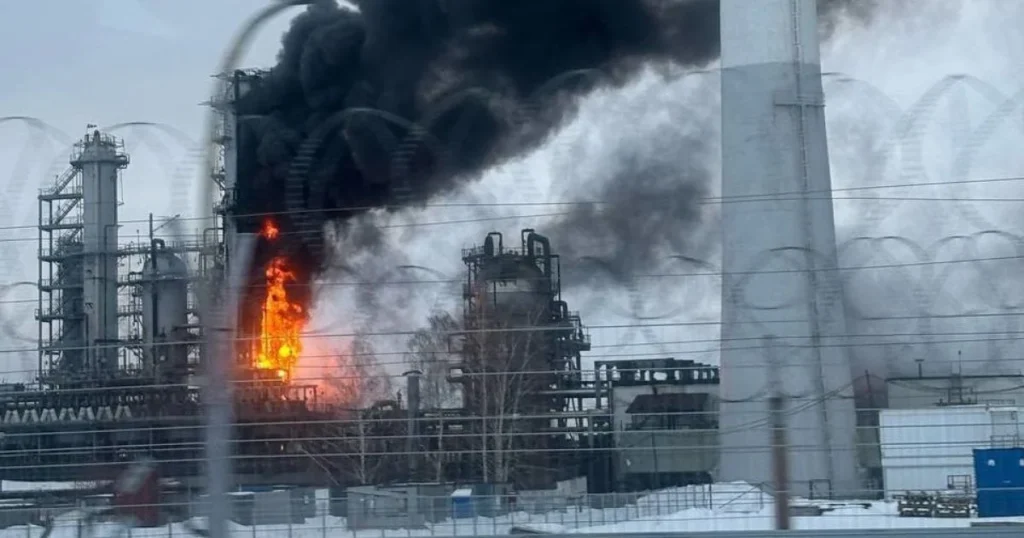
фото: росЗМІ
Source: Author’s Facebook page
Russia is currently not demonstrating any real readiness to end the war. On the contrary, the Kremlin continues to pursue the logic of prolonging the conflict, counting on time working in their favor. In their opinion, a war of attrition should gradually undermine Ukrainian capabilities and force Kyiv to accept Moscow’s conditions.
This logic is not new. It is based on the belief that Russia’s resources are greater and its political system is more resilient to long-term shocks. But this strategy has a weak point: the economy.
The Russian economy remains vulnerable, and this vulnerability has a clear source: dependence on the oil and gas sector. Despite all attempts at diversification, energy exports continue to provide the key source of budget revenue. Formally, we are talking about approximately 20%, but in reality, the impact is much wider. If we take into account related industries, employment, and domestic demand in regions with concentrated oil refining, it becomes clear that this share can reach 40–50%.
That is why strikes in this area have not tactical but strategic significance.
Ukraine has already demonstrated that it is capable of striking Russia’s critical infrastructure—oil depots, terminals, and processing facilities. And this opens up a completely different logic of war—not only a frontal one, but also an economic one. What can be conditionally called “sanctions at a distance” may turn out to be much more effective than traditional diplomatic efforts.
After all, negotiations during the active phase of a war are almost never decisive. They do not guarantee the implementation of agreements and often only fix the current balance of power. And the balance of power, in turn, is determined not by words, but by resources.
External circumstances are currently partially in Moscow’s favor. Instability in the global energy market, associated with conflicts in the Middle East, allows Russia to retain revenues from oil exports. But this is a temporary factor. The market is changing, and in the long term, it cannot compensate for systemic losses in infrastructure.
It is the gradual destruction of this infrastructure and the increasing cost of war for Russia itself that may change its behavior. This is not about a political “insight” on the part of the Kremlin, but about something much more prosaic—the need to save its own economy. At some point, the Russian authorities may be forced to agree to a pause not because they want peace, but because they need time to recover.
Ukraine has, in fact, already realized one of Russia’s key weaknesses. The only question is how systemic and long-lasting this pressure will be.
Because the outcome of this war will be determined not only by events on the battlefield but also by the ability to undermine the economic basis of aggression. And if this pressure is sufficient, the Russian economy may sooner or later prove unable to meet the needs of the war.
And then it’s not the rhetoric that will change—it’s the reality itself that will change.
Recall that in March, Russia’s oil tax revenues fell sharply—almost halved compared to last year. This hit the budget, but within a few weeks, the situation began to change due to a jump in oil prices.
In addition, Russia is threatened with a reduction in oil production, as Ukrainian attacks on ports, pipelines, and refineries have significantly reduced the Kremlin’s export capabilities.
As is known, over the past month, Ukraine has intensified attacks on infrastructure related to the export of raw materials. In order to weaken the Russian economy, the Defense Forces have struck at Baltic ports. In particular, after the attacks, one of them—”Ust-Luga”—stopped oil exports.
In addition, in Russia, after drone attacks, two oil refineries belonging to Rosneft—the Tuapse and Novokuibyshev refineries—were suspended.
Also, follow “Pryamyi” on Facebook, X, Telegram, and Instagram.
• Materials published in the “OPINIONS” section reflect the opinion of the author of the publication, who bears full responsibility for the accuracy of the information.
• The editorial staff of prm.ua may not share the opinions expressed in the author’s material.
• The owner of the webpage in the “OPINIONS” section is the author of the publication.